Cryptids of North America #15: North Carolina
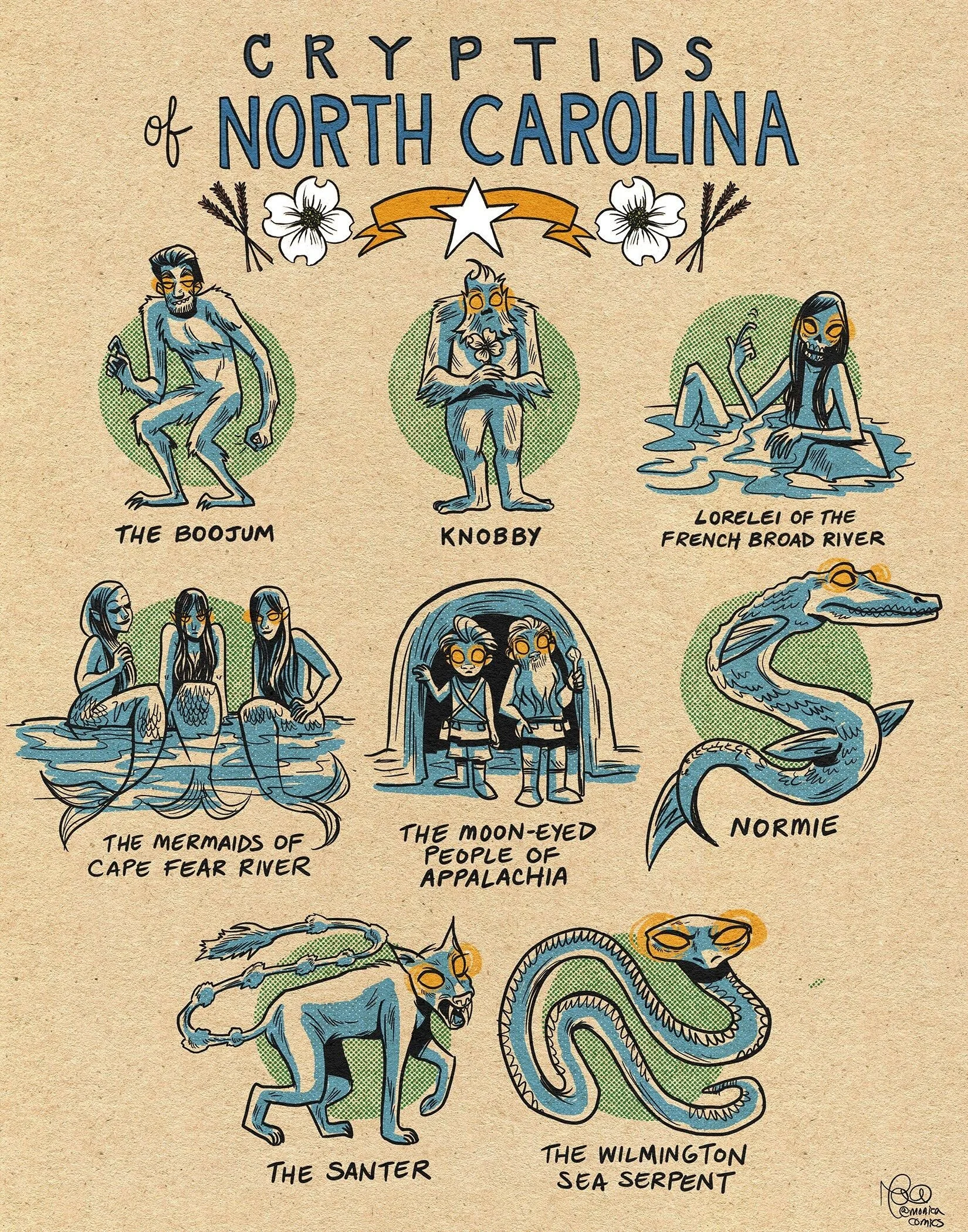
Artist credit: LipstickKissPress on Etsy
It’s been a while since the last entry in my cryptozoological road trip (about four months, to be exact), but it’s finally time to start the Deep South leg of our tour in the Tarheel State, a nickname derived from the tar, pitch, and other products developed out of its bountiful pine forests.
North Carolina is notable for being the site of the first British colony ever established on North American soil on the island of Roanoke in 1585. Unfortunately, the Roanoke Colony has also gone down in history as one of the most famous mysteries in American history, as all of its 120 members vanished in the three years it took Governor John White to travel back to England to resupply. The only clue to their whereabouts was the word “Croatoan” carved on a nearby tree (referring to an island now known as Hatteras). Bad weather and a lost anchor prevented White from searching the island, and so the fate of the colonists (including North America’s first English baby, Virginia Dare) remains uncertain to this day.
North Carolina has since become world-renowned for being the site of the first controlled airplane flight, conducted by Orville and Wilbur Wright at Kill Devil Hills on October 17, 1903. It currently hosts two of the fastest-growing metropolitan areas in the United States in the form of the so-called Research Triangle (Raleigh, Durham, and Cary) and Charlotte, home to America’s biggest banking sector outside of Wall Street.
But, of course, that’s not what we’re here to talk about today. We’re obviously interested in cryptids, and North Carolina has a lot of them. I managed to gather a list of 16, making it one of the larger numbers I’ve collected for a state thus far. As always, let us thank Monica Gallagher and Kaitlyn Bullock for introducing them to us, and let’s get cracking!
Averasboro Galinipper
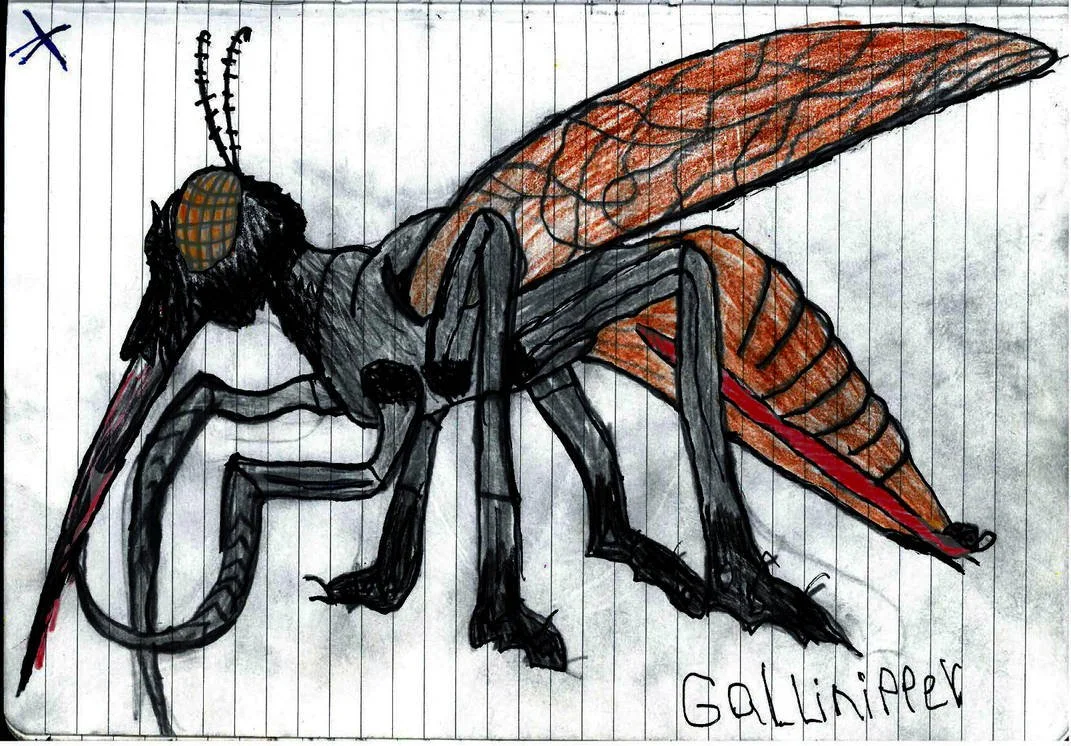
Artist credit: theRunningmandev on DeviantArt
In natural science, gallinippers are exceptionally large mosquitoes belonging to the species Psorophora ciliata, known for their aggressive behavior toward humans and other large mammals (my family and I even fought a few off while sitting around the campfire on July 4th evening). In terms of folklore, however, the gallinipper is a mosquito of monstrous size, ranging from the size of a hawk to so big that, according to some African American versions of the legend, their bones could fence in a 140-acre field (I assume they mean the exoskeleton, since mosquitoes are invertebrates). It was especially feared by loggers around the Outer Banks region (especially around Cape Fear), as they were said to be able to completely exsanguinate an adult human in a single gulp. Sightings apparently reached their height in the 1850s, with one logger named Red Saunders claiming to have survived being bitten by one in 1855 (some versions of the story claim he was touched by a hot coal instead).
Averasboro comes into this story around the same time, according to John Hairr, author of Monsters of North Carolina. He claims to have found records of a tavern in the Cumberland County community that displayed what it claimed to be a gallinipper skeleton back in the 1850s. Of course, Hairr argues that the giant “mosquito” skeleton was actually that of a large bird (possibly a tundra swan) that had its bill removed and replaced with “a long, scrimshawed piece of bone that tapered to a point like a large needle.” In other words, it was a hoax, similar to other supposed taxidermy cryptids of 19th-century America.
Interestingly, giant insects show up in several Indigenous legends from around the region. The Tuscarora (an Iroquoian-speaking people who joined the Haudenosaunee Confederacy in New York after being kicked out of North Carolina by white settlers in 1715) told stories of a human-sized mosquito named Ro-Tay-Yo, who killed many warriors by sucking out their blood until one lucky archer pierced its heart with an arrow, causing it to explode into a swarm of smaller mosquitoes (thus giving a mythological origin story for the annoying little bloodsuckers). The Cherokee told a similar story about a large insect they called U’lag’u (meaning “the boss” in their language), although this creature was instead a yellow jacket large enough to carry children away to a cave called Tsgagnun’yi (“where the yellow jacket was”). One day, when the Cherokee had enough of the bug’s child abductions, they cornered U’lag’u in his cave and smothered him to death with campfire smoke. He also exploded into a swarm of smaller yellow jackets upon his death.
Nowadays, Averasboro is a ghost town whose former location is marked only by a cemetery and a Civil War museum. While it would be funny to believe that it was abandoned because the gallinippers killed them all, it would be more accurate to blame the Ku Klux Klan and the Southern Railway Line, which benefited the nearby town of Dunn more than Averasboro, with the post office permanently closing in 1903.
Bigfoot
An alleged picture of a Bigfoot taken in Boone in 2018 (posted on r/bigfoot on January 1st, 2023)
Much like its neighbor, Virginia, North Carolina is a bit on the lower side when it comes to Bigfoot sightings, with 107 logged by the BFRO. Compare this with another state we’ve covered, Ohio, with 335 sightings logged. Sightings apparently date back to 1793, with the BFRO hosting a link to a Boston Gazette article dating to July 1st of that year involving sightings in the Bald Mountains in Madison County. Unfortunately, much like the article for the oldest West Virginia sighting, the link only leads to a 404 error page.
Rather than my usual tactic of going through every sighting in strict chronological order, however, I want to try something different here: go through the different reported Bigfoot sighting hotspots in North Carolina and give a brief list of notable sightings from each location. The ones I keep coming up in my research are Pisgah National Park in the western part of the state (with BFRO recording 24 sightings in the twelve counties it covers) and Uwharrie National Forest, centered in Montgomery County (which has 15 sightings listed by the BFRO, the most of any county in the state). Now let’s take a closer look:
Uwharrie:
June 1990: A couple was driving along Highway 220 north of Candor when a large figure suddenly stepped over a four-foot fence running alongside the road and started walking across the road in “a smooth, almost gliding movement…It ran on two legs the whole time,” the witness continues, “and was slightly hunched over as it ran. It was covered in black/brown fur, and the head was set low on the shoulders.” The witness had no estimate of its size, only saying that it was “huge.” It then stepped over the fence on the other side of the road and vanished into the thicket.
June 2004: A father and son out camping in Uwharrie had left their site to fetch some biscuits for breakfast when they were stopped in their tracks by a brownish-black animal walking downhill on two legs on the side of the road. It stood tall enough to completely obscure a 7’4” road sign as it walked past it. It paused for a few seconds and glanced at the witnesses before disappearing into the bushes. The witnesses investigated the site and were unnerved to find no obvious signs that a large animal had passed through (not even footprints), despite just seeing one with their own eyes.
April 15, 2014: A gold panning hobbyist was panning in a creek 200 yards away from Thickety Creek Road when something started throwing rocks at him. He became especially unnerved when a rock the size of a junior football flew over his head and landed on the opposite bank. The panner pulled out a 9mm pistol and shouted a warning at his assailant as he packed up his things and made a break for his truck. He was frightened enough by the incident that he gave up gold panning and hunting for years.
November 8, 2014: Two men camping near the north section of Dutchman’s Trail had just turned into their hammocks between 7:30 and 8:00 when they heard the sound of a large animal breaking branches as it walked along the creek bank. One of the men yelled at it, only for the creature to start banging large rocks together and throw them at the campsite. The commotion caused an uproar among the songbirds and owls. Later that night, at around midnight, the men heard dogs barking in the distance, followed by a long and eerie wail.
September 24, 2015: A man was hiking along Dutchman’s Creek at 10 a.m. when he was startled by a series of loud wood knocks. The witness noted that the knockers seemed to be communicating with each other. This continued for several minutes until the witness suddenly heard a huffing sound coming from the ditch to his left. He was unnerved to notice no movement in the brush, which he would have expected if it was a deer or bear making the sound. The witness’ paranoia wasn’t helped when a “guttural baby moan or call” started issuing from the bushes, which again were unaccompanied by the expected rustling of the brush. He claims the sounds resembled nothing he had ever heard before or since.
October 25, 2015: A man camping with his wife and dogs near the entrance to the Uwharrie campground had decided to spend the night outside the tent in a hammock, only to be startled awake at 2:30 by unseen creatures loudly breaking branches. These noises lasted between 45 minutes and one hour, and were accompanied at one point by an odd vocalization the witness described as “similar to the noise a deer makes when it’s alerting other deer to danger, but if a deer were to make this noise it would have to be 20 feet tall.” Eventually, the witness retreated into the relative safety of his wife’s tent. When the couple inspected the area the next day, they found no evidence that any large animals had passed through, other than some mushrooms with their tops bitten off and their stems discarded.
June 18, 2020: A couple was driving on Highway 109 north of Mt. Gilead when the wife caught a glimpse of an eight-foot-tall black figure with a lighter colored hands and face as it crossed the road and headed for some nearby railroad tracks. The sighting only lasted for 5-6 seconds, and the husband was too busy checking on a car following behind them to notice.
Pisgah:
April 1983: A Wisconsinite was driving back home from spring break in Daytona Beach at 2 a.m. when he had to slam his brakes on Highway 26 outside Hendersonville. The reason for his sudden stop was a 4-5’ tall creature walking on two legs across the road, covered in shaggy brown hair and sporting a pointed head. When the witness’s two friends (who had been sleeping in the back seat) asked him what had happened, he replied that he had “just seen a Jawa walk in front of the car,” as he had mistaken the creature’s thick coat for a hooded cloak at first.
October 2003: A pair of campers at Big Creek Campground in the Great Smoky Mountains were heading to the restrooms to get ready for bed when they noticed that a nearby deer herd seemed agitated. As they tried to figure out what was the matter, a long primate-like call suddenly rang out through the woods. The witnesses would later describe it as sounding like a gibbon, but larger.
July 5, 2005: A Hot Springs family was staying at their grandfather’s house in Pisgah and started playing a CD with supposed Bigfoot sound recordings. It seemed to provoke a response, as they heard the sound of branches breaking, including what sounded like a ten-inch tree trunk being broken and thrown down the mountainside, which made everyone run for the safety of the front porch.
When BFRO investigators questioned the witnesses, they said the location was a hot spot for Bigfoot-type activity. Two men from the family were out hiking in August 2001 when a volleyball-sized rock was suddenly hurled at them. They saw the culprit squatting on a bluff 40 yards away, covered in reddish-brown hair and sporting arms so long that the elbows could rest comfortably on its toes. The witnesses quickly hightailed it out of there.
A BFRO investigation began in August 2006 after the family reported wood knocks along with more thrown rocks and logs. The team encountered possible footprints, a strange stick formation, and weird noises.
September 30, 2008: A witness staying with an elderly friend at her mountain home outside of Little Switzerland claims to have experienced a three-day-long streak of Bigfoot-type activity starting on this date. It began when he stepped out for some fresh air at 11:30 that night, only to be startled by wood knocks. The witness recalls making his own knocks by banging on a wood pile and stomping on flagstones in the front yard. He was answered by stones striking the roof of the cabin, as well as a glimpse of a furry grey figure slipping into the woods on the side of the road.
The next day, the witness stumbled across footprints while jogging and felt as if he were being watched. That night, he heard more wood knocks, as well as “a plaintive, eerie howling coming from the south.” He decided not to answer and went inside to read a book, only to be interrupted by what sounded like heavy footsteps on the roof. Later that night, he was awakened by what sounded like pounding on the outside walls. He couldn’t see the culprit through his bedroom window and soon went back to sleep.
While the owner of the house insisted that she had never experienced any unusual activity in her woods, the witness claims that someone else staying at the house also experienced banging on the roof and walls.
July 2009: An eleven-year-old boy living on Old Fanning Bridge Road was walking over to a friend’s house at 11 p.m. when he noticed something standing at the edge of a pine grove as he walked through a field. It was a humanoid figure standing 7.5- 8’ tall. When the figure noticed that the boy was looking at him, it suddenly took off through the brush, screaming its head off. The frightened boy, in turn, ran the rest of the way to his friend’s house.
November 9, 2010: A motorist was driving home from work at a Linville resort when he noticed something unusual in the Linville River as he crossed over the bridge. He described it as a chestnut-colored object standing in the river 100 feet away from the bridge. The creature turned its head when the witness slammed on the brakes, revealing that it had no snout or pointed ears, something it should have possessed if it was a black bear. It was seven feet tall with a hairless face, arms that hung down to its knees, and an egg-shaped cranium. The witness’s view got obstructed by an embankment as the car came to a stop. By the time he got a clear view of the spot where the creature stood, it was gone.
September 10, 2011: Dawn Hinkle was on a family camping trip at the Davidson River Campground when she and her daughter stepped out of the tent at 1 a.m. to answer a call of nature. They were not expecting to see an 8-9’ Bigfoot standing behind their tent, covered in white fur and peeking out from behind a tree. They further described dark brown eyes, a gorilla-like face, and arms and legs proportionally longer than a human’s. The encounter ended when the duo slipped back into the tent and the rest of their night passed uneventfully, albeit without much sleep.
January 22, 2012: A group of three children playing outside along Highway 209 in Hot Springs, along with their two adult supervisors, heard strange yelps and whistles coming down the mountain toward them, which the kids tried to imitate. As the sounds got closer, one of the children tried to take a dog into the woods with him to investigate, but the animal seemed frightened and refused to go. One of the adults recalled a rancid smell coming from the forest. This was only one of several strange incidents reported from the area, which also included hunting traps having their bait stolen, wood knocks, dogs becoming fearful and skittish when entering forested areas, camera traps taking seemingly empty photographs, feelings of being watched, and a hunter claiming to see a 6-7’ creature while hunting near Wholly Shot Road.
Miscellaneous:
September 19, 2023: Redditor TrashMammal84 posts a story on r/bigfoot about a story their best friend told them about something the friend’s uncle saw while hunting on the Neuse River. The witness claimed to see a creature “at least 8’ tall with an enormous chest and shoulder width…covered in shaggy reddish brown hair that was rather long.” The creature seemed to quicken its pace when the uncle made eye contact with it, and it vanished into the trees as suddenly as it appeared. The uncle admitted to raising his rifle at the beast, despite never having any intention of shooting it.
North Carolina also has a surprisingly large number of attractions and festivals centered on Bigfoot, possibly the most outside the Pacific Northwest. The biggest of these is undoubtedly the WNC Bigfoot Festival in Marion, which draws up to 30,000 visitors to McDowell County every August 29th. Other notable attractions include the North Carolina Cryptozoology & Paranormal Museum in Littleton (which includes an eight-foot life-size statue of Sasquatch) and Bryson City’s Bigfoot hunting hike, which takes visitors on a four-hour hike around the city to look for signs of the elusive creature for $94 per person. It doesn’t seem to have turned up much evidence yet, but who knows? Maybe you can be the first!
The Beast of Bladenboro
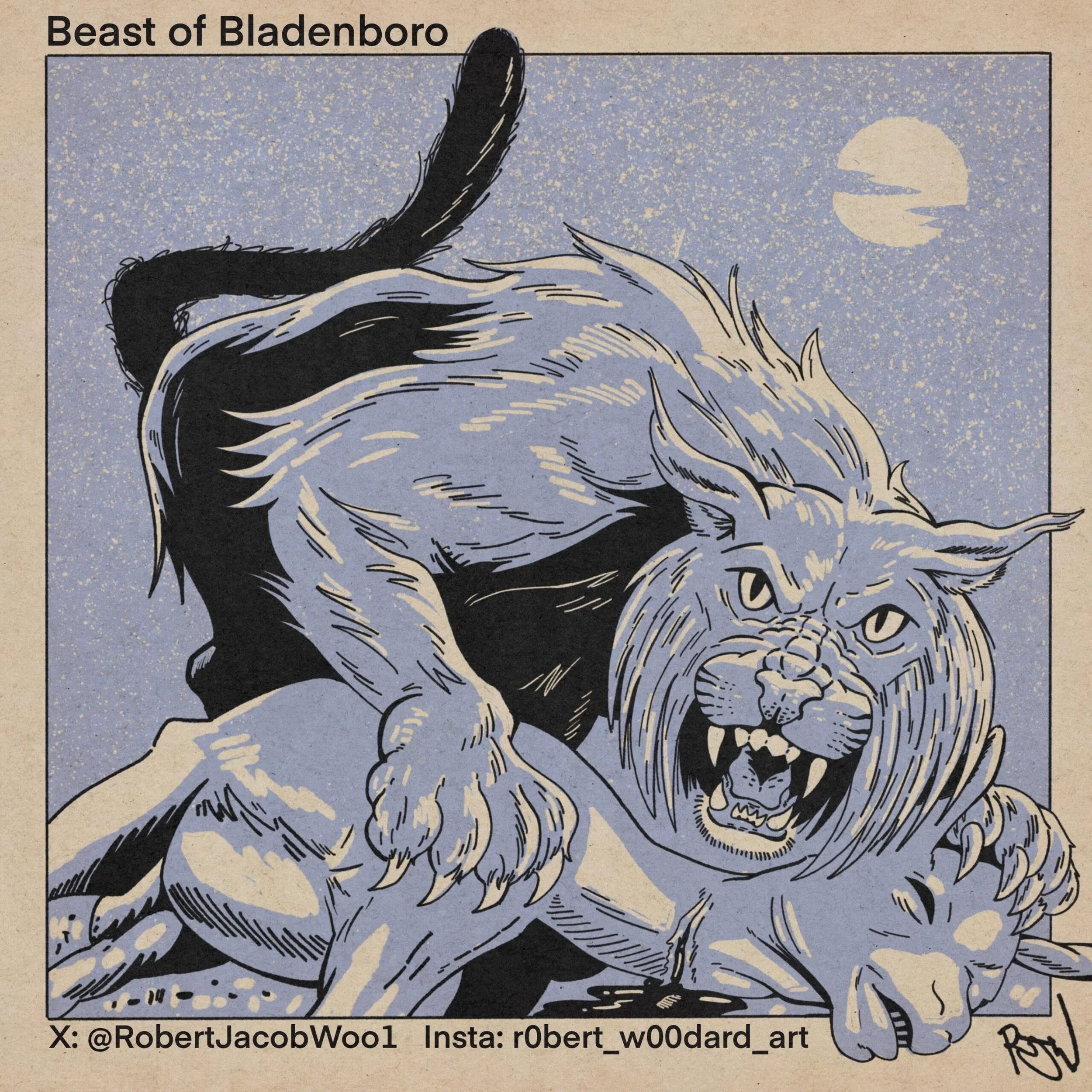
Bladenboro might sound like the name of a hideout for assassins in a bad fantasy novel, but it’s actually a peaceful small town in Bladen County in the southern reaches of the state. It wasn’t always this way, though, as the village was besieged by a bestial assassin of livestock and dogs during the winter of 1953-54.
The saga of North Carolina’s most famous cryptid began on December 29 in the nearby town of Clarkton, when a local woman’s dog was killed by a creature described as “sleek, black, [and] about five feet long.” Two days later, Bladenboro resident Johnny Vause discovered his two dogs “torn into ribbons and crushed” in their kennels. The Charlotte News quoted his harrowing description of the scene:
My dogs put up a good fight. There was blood all over the porch, big puddles of it. And there was a pool of saliva on the porch. It killed one dog at 10:30 and left it lying there. My dad wrapped the dog up in a blanket. That thing came back and got that dog, and nobody’s seen the dog since. At 1:30 in the morning, it came back and killed the other dog and took it off. We found it three days later in a hedgerow. The top of one of the dog’s heads was torn off, and its body was crushed and wet, like it had been in that thing’s mouth. The other dog’s lower jaw was torn off.
Five more dogs would perish at the Beast’s claws over the next three days. A veterinarian who conducted an autopsy on one of the corpses was quoted by the Wilmington Morning Star as saying that “the victim’s bottom lip had been broken open and his jawbone smashed back” and that “there wasn’t more than two or three drops of blood in him.” It was from this quote that rumors of the Beast having vampiric tendencies (much like the Chupacabra about a half-century later) started to spread. Meanwhile, bodies kept piling up: a decapitated pet rabbit on January 5th, a dead dog on January 7th, and a goat with a crushed skull later that same evening.
The fantastical rumors weren’t helped by the strange features reported by witnesses who actually saw the Beast. One description provided to the Wilmington Morning Star read as follows:
It was about 20 inches [50 cm] high. It had a long tail, about 14 inches [35 cm]. The color of it was dark. It had a face exactly like a cat. Only I ain’t ever seen a cat that big. It was walking around stealthy, sneaky...
Other witnesses described it as resembling a cross between a bear and a panther, measuring four feet long and anywhere from 80 to 150 pounds. Some local hunters claimed to have found tracks indicating that the Beast had inch-long claws and was moving in circular patterns, as if attending to a mate or an offspring. Sure enough, at least one eyewitness reported seeing the Beast with a cub.
One local woman claimed to The News and Observer that the Beast had charged at her after she stumbled upon it harassing some more dogs, and that it veered away when she screamed at it. Other witnesses reported that the Beast made odd noises similar to a crying baby.
Naturally, hunters went out in droves looking for the Beast, with the search expanding from 500 people on January 5 to 1,000 by January 7. The local police had to step in at that point to stop the hunt from getting out of control. They also had to dissuade their chief, Roy Fores, from using dogs as live bait, as they considered the method too cruel, especially when a humane society in Asheville caught wind of the plan and sent a strongly worded telegram. Mayor Woodrow Fussell declared on January 8 that no more hunts were to occur until another sighting was reported or another dead animal carcass turned up.
On January 13, no less than three different hunters claimed to have taken the Beast down. The first claimant, Luther Davis, found and shot a bobcat that he found caught in a steel trap in the Big Swamp. The second, Berry Lewis, shot another bobcat while hunting in a different part of Bladen County. The third, Tabor City resident Bruce Soles, was driving out of Bladenboro when he hit a strange cat with his car. He described it as being “spotted like a leopard,” about 20 to 24 inches (50 to 60 cm) high, and weighing between 75 and 90 pounds (35 and 40 kg). Mayor Fussell was photographed posing alongside Davis with his bobcat held up between them (though some believe it was Lewis’ bobcat he posed with instead).
Not everyone is convinced that Davis killed the Beast, as they thought that a bobcat was too small to cause the kinds of injuries inflicted on the animals of Bladenboro. Lumberton resident A. R. Stanton believed that the culprit was a mixed German Shepherd/hound dog named Big Boy that he had given to an Indigenous child who lived near Big Swamp shortly before the attacks. Big Boy had been known to leap six-foot-high fences and break into chicken coops from time to time. The Beast’s Wikipedia article mentions a stray dog being killed on December 16, 1954, after five pigs and three chickens were killed on a tenant farm near the Robeson Memorial Hospital. This article from The Robesonian describes it as “a cross between shepherd and collie.”
Other theories included that the Beast was a coyote, a wolf, or possibly even a wolverine (how it would have gotten to Bladenboro is anyone’s guess, since wolverines aren’t endemic to any part of the US east of the Rocky Mountains). The most commonly suspected culprit, however, is that the Beast was a mountain lion that had somehow made its way back into a state it had been extirpated from a century before. Indeed, that was the conclusion of an episode of the History Channel series MonsterQuest when it went to Bladenboro to investigate a similar series of killings in 2007. Tom Padget, a former biologist who worked for the North Carolina Wildlife Resources Commission, said that it was the only animal he could think of that could cause the type of injuries reported, which were far beyond the capabilities of any carnivoran native to North Carolina.
Whatever one thinks of the Beast of Bladenboro, it has been embraced by its namesake town as a mascot of sorts, with the local organization Boost the ‘Boro holding an annual feast to boost the small town’s profile. Hey, it worked for Point Pleasant. Why can’t it work in Bladenboro?
The Boojum
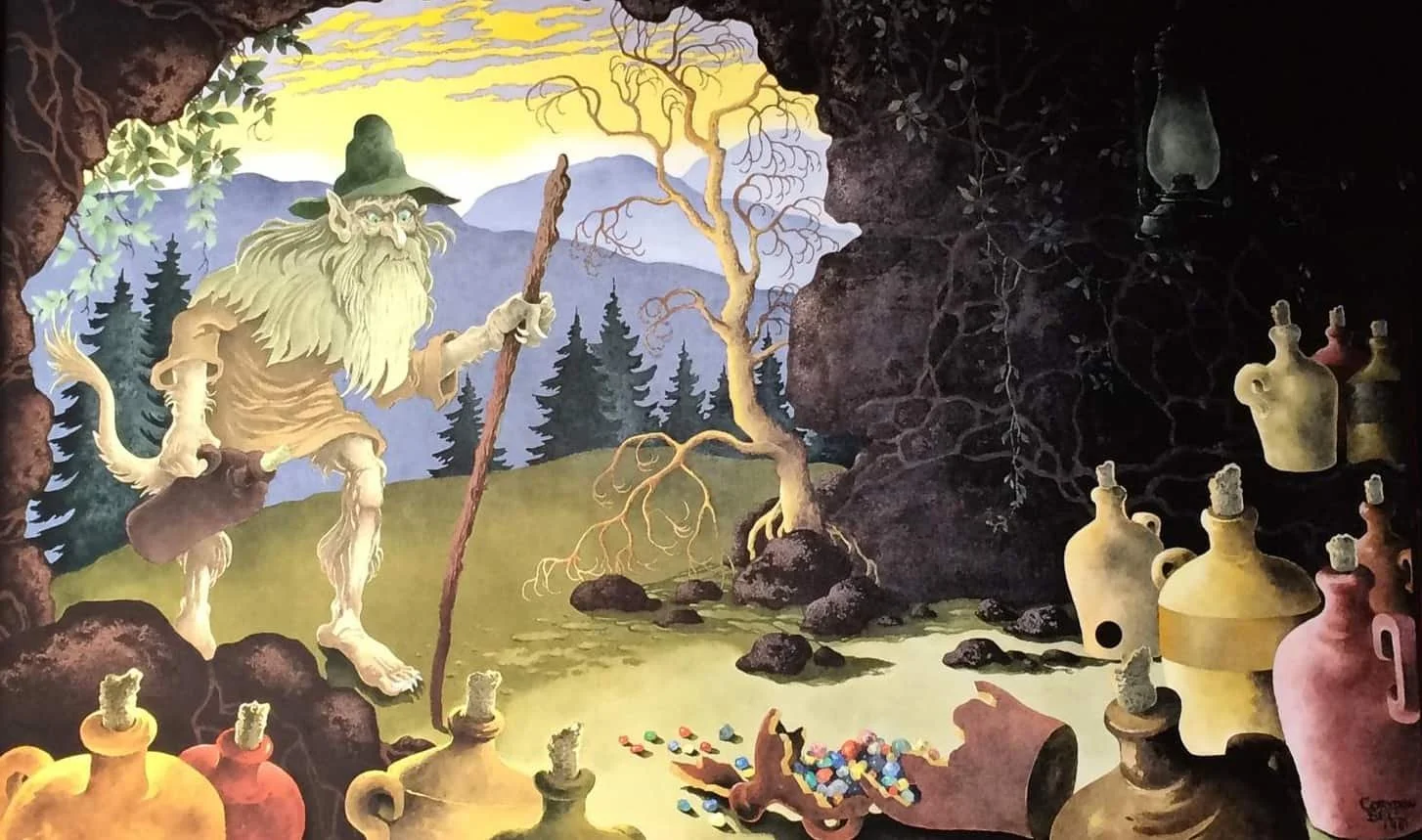
Artist credit: Cordon Bell (1961)
It’s not that weird cactus-like tree that grows out in Baja California that we’re talking about, nor is it the creature from the Lewis Carroll poem The Hunting of the Snark that can erase a person from existence just by looking at them. This Boojum is more of a classic American folktale character halfway between a Sasquatch and one of Snow White’s seven dwarves.
He is said to live in Haywood County, making his home in the caves dotting the Appalachian range known as the Blott Balsams. He is said to largely resemble a man, except that he’s eight feet tall and covered with shaggy gray hair on every part of his body except his face. Local cartoonist Craig Payst claims that, “Boojum ain’t quite a man. He ain’t quite a bear. He ain’t quite an ape. He ain’t quite a raccoon neither. He ain’t quite nothin’ ‘cept bein’ just Boojum.”
Aside from his appearance, the Haywood County Boojum is noted for two major personality quirks. The first is that he has a fondness for gemstones like rubies, amethysts, emeralds, and sapphires, which are plentiful throughout the Appalachians. He would steal discarded liquor jugs to keep them in and then hide them inside one of the many caves which he called home. He would also fill the jugs with moonshine in the hopes that any human treasure hunter who stumbled across his hoard would not be able to resist the urge to drink it and then pass out in a drunken stupor, thus allowing Boojum to spirit the gems away to a more secluded location.
His other major personality quirk was that he loved to watch young women bathing in the many mountain streams that dotted his territory. These acts of voyeurism usually ended with the women spotting his hairy face leering at them from the bushes and running away screaming. Sometimes, this would escalate into male villagers forming a posse to hunt this hairy Peeping Tom down, although Boojum always had enough places to hide to avoid this mob justice.
One day, however, he stumbled across a young woman named Annie who didn’t run away when she saw him in the bushes. Instead, she took pity on the lonely Boojum and decided to run away with him into the mountains, much to her family’s dismay. Their otherwise happy marriage was only spoiled by Boojum’s tendency to disappear into the wilderness for long periods in his hunt for new gems. They thus developed a system to signal Boojum back to Annie’s side when the lonelieness grew too much for her to stand; she developed a holler that sounded like a mix between a monkey and an owl, and Boojum would answer back until they found each other once again. Folklorist John Parris has even claimed that this story is where the common Appalachian colloquialism “hootenanny” came from, referring to either an informal party or social gathering (often including folk music) or as a placeholder name for something unknown or forgotten (similar to “doohickey,” “thingamajig,” or “whatchamacallit”).
Nowadays, Boojum lives on through a brewery in Waynesville that is named after him, as well as continued sightings of hairy manlike beasts reported in the Haywood County woods to this day. Are these the descendants of Boojum and Annie, or are they cousins of Bigfoot and the other hairy hominds lurking throughout North America’s wildlands? Maybe that’s for you to decide.
The Brown Mountain Lights
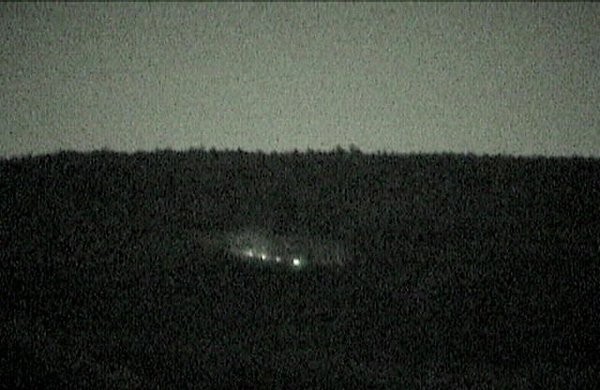
This is almost certainly the most famous paranormal story to come out of North Carolina. Centered on Brown Mountain (which is more of a low-lying foothill than a mountain), which is located in Pisgah National Forest north of Morgantown (near the border between Burke and Caldwell Counties), there have been ghostly lights reported on or around the mountain since the early 1900s, and possibly even earlier if various local legends are to be believed.
The legend was popularized by a report in the Charlotte Daily Observer on September 24, 1913, which claimed that red lights had been spotted near the horizon every night at 7:30 and 10:00. The sightings were so regular that D.B. Sterrett of the U.S. Geological Survey was called in to investigate. He concluded that the lights were caused by the headlights of steam locomotives passing along the Southern Railway. The aforementioned punctuality of the lights no doubt influenced his assessment.
His conclusion was thrown into question after a flash flood in July 1916 when locals claimed the lights were still visible despite all the railways around Brown Mountain being washed out. This likely cemented the widespread perception the the lights were of supernatural origin.
Various ghostly legends thus became attached to these Appalachian will-o’-the-wisps. Some claimed that the Cherokee knew of the lights and ascribed them to the spirits of native women searching for the souls of the fathers, brothers, sons, and other loved ones who died in a 13th-century battle between them and the Catawba tribe from modern-day South Carolina.
Meanwhile, white settlers ascribed various stories of murder and disaster to explain the lights throughout the 1800s. One story claimed the lights were the ghost of a young woman who died of a broken heart, either when her boyfriend died in a flash flood or when her boyfriend was murdered by a jealous rival. Another story tied the lights to a woman named Belinda who was murdered by her abusive husband, who got away with the crime until years later when a ghostly light led a local search party to Belinda’s skull, which was undecayed and thus, according to Appalachian superstition, the skull of a murder victim.
Another theory, proposed by local lumberjacks, was that the lights were reflecting off the gems that were abundant in the Appalachians. They never found enough of the precious stones to prove their theory, though (because, obviously, Boojum stole them).
These reports were seemingly bolstered by supposed sightings from before the electrification of the Brown Mountain area in 1910. For instance, the German cartographer, engineer, and mystic John William Gerard de Brahm allegedly described seeing “nitrous vapours…arsenical and sulphureous” rising off the North Carolina Appalachians in 1771. A story passed down through the Wiseman family claims that in 1854, a then-twelve-year-old Josiah Lafayette “Fate” Wiseman was camping with his father at a site now known as Wiseman’s View when he saw a light on Brown Mountain that would appear at regular intervals. Fate would later tell this story to future country music singer Scotty Wiseman, who went on to write a famous song about the lights, claiming that they were coming from the lantern of a faithful slave searching for his lost master (a theory that is quite popular in the post-Jim Crow era, I’m sure). They even got tied to UFO lore in the latter half of the 20th century, especially after Ralph Lael claimed to have met aliens on Brown Mountain in 1965 that took him to the planet Venus.
What none of these stories take into account, however, is that the USGS conducted a second, much more thorough investigation in 1922, this time led by George R. Mansfield. His conclusion, available in PDF form here, was that the lights were caused by a variety of different perfectly ordinary light sources (47% automobile headlights, 33% locomotive headlights, 10% stationary lights, and 10% brushfires, as he estimates in the report). He also found no mention of the lights in print before the 1913 Daily Observer article, nor any eyewitness accounts before 1897, which casts serious doubt on the authenticity of the earlier legends.
The supposed de Brahm sighting is also much less compelling when you realize that the passage in which he supposedly described the Brown Mountain lights is merely his attempts to theorize where thunderstorms come from through an alchemical lens (also, while he did plenty of surveying in South Carolina, there is no hard evidence that he ever set foot in North Carolina). The Fate Wiseman story is also hard to take at face value since it took until 1922 for a 13-year-old Scotty Wiseman to hear about it, and another 39 years before he wrote the song about it. Still, if Fate did see lights, they may have belonged to the Morganton-Salisbury train, which started in 1858 and was the first railway established in the western half of the state.
Finally, there are enough cameras monitoring Brown Mountain in the 21st century, mostly operated by Appalachian State University, that someone should have seen at least one light that couldn’t be explained by conventional means. So far, though, none of the lights they have observed on the mountain have been supernatural in nature. Some have also speculated that Jules Verne’s novel Master of the World (published in 1906 and translated into English in 1911) may have influenced the legend, as it involves a mad scientist building an airship under nearby Table Rock, which causes strange lights to appear in the sky.
Despite this, the lights remain a popular tourist attraction to this day. Popular viewing spots include Wiseman’s View, the top of Table Rock, the Brown Mountain Overlook on Highway 181, and the 301 and 310 mileposts on the Blue Ridge Parkway. Now, if professional scientists haven’t seen any lights that they couldn’t explain, I can’t promise you will. Still, it can’t hurt to look, can it?
The Cross Fairies

Known to geologists as staurolites, these unusual stones are a type of metamorphic rock (that is, a stone that has been transformed via intense pressure or heat that is not quite extreme enough to melt it) where the unique conditions it’s formed under cause it to take on a cruciform, or cross-like, shape. They are extremely rare, found only in Norway, Minnesota, New Mexico, Idaho, and, most relevantly for this article, in the stretch of Appalachians between Fannin County, Georgia, and Patrick County, Virginia.
As you might gather from the name of this section, folklore has often ascribed their origin to fairies and other similar little people. The legend most relevant to this article concerns that of the Cherokee and their resident fair folk, the Nûñnë'hï (meaning “the people who live anywhere” in the Cherokee language). These little people were said to be good friends with the Cherokee, often helping lost wanderers and warning their human neighbors of danger, although they usually liked to keep to themselves and would magically teleport their dances to a different location if human hunters threatened to stumble across them.
All was well in the land of the Cherokee and Nunnehi until the fateful year of 1838, when the white settlers forced the Cherokee off their ancestral land and forced them to march on the Trail of Tears alongside the other so-called “Five Civilized Tribes” of Seminole, Chickasaw, Choctaw, and Muscogee Creek, thousands of whom died before reaching their final destination in modern-day Oklahoma. It is said that as the Cherokee left their homeland behind, the Nunnehi wept, with their tears transforming the rocks into the cross-like shapes we see today. Later retellings claim the fairy crosses were formed when the fairies learned of Jesus’ death on the cross.
However, another Cherokee folk tale tells of how the Nunnehi convinced some of their human neighbors to hide with them in a cave, with a large stone rolled over the entrance. After seven days, the stone was rolled away, and the Cherokee stragglers were free to continue living in their ancestral homeland. They continue to live in what is now North Carolina to this day as the Eastern Band of Cherokee Indians, on land bordering Great Smoky Mountains National Park.
Whatever one thinks of the crosses’ origins, they are widely regarded in Appalachian culture as symbols of good luck and protection, often passed down between generations as family heirlooms. Be careful picking one up for yourself, however, as many areas have guidelines for safely removing them so as not to disturb the natural beauty of their surroundings.
The Devil’s Tramping Ground
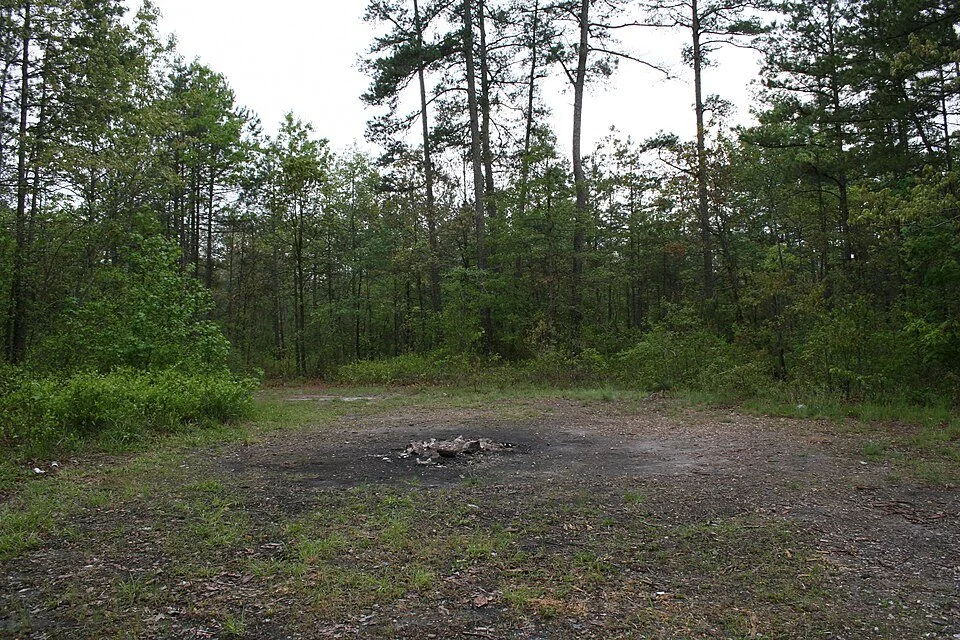
Image found on Wikipedia (By Jason Horne, CC BY-SA 2.5, https://commons.wikimedia.org/w/index.php?curid=10597767)
There is a strange circular spot in the pine woods of the Chatham County community of Bear Creek where it is said no plant ever grows, dogs and other animals refuse to enter, and any object placed in the middle is found thrown out the next morning. According to local legend, there can only be one explanation: it is a favorite hangout spot for Satan himself, where he dances and paces in a circle while brainstorming new schemes for tormenting us puny humans and dragging our souls to Hell.
The legend dates back to at least January 1882, according to Brian Dunning’s investigation. A letter to the editor of the Weekly Star, authored by H.T. Ivy, describes a spot “3 miles from the Randolph line” which he claims has been known as the Devil’s Tramping Ground since the oldest resident’s grandparents were alive. He describes it as being a circle 25 feet in diameter, consisting of sand and red clay, with no plants except wire grass able to grow there. He also claims that local Indigenous people “have all of them a superstitious dread of the place,” and that the guide he took with him begged him to leave the place, but not before Ivy dug three feet into it and found nothing of interest. The site’s official website also claims that there are alternate Native American-centered origins for the tale. One claims that nothing grows there because that is the spot where the natives would do a war dance after a big feast (which feels lowkey racist, not gonna lie) while the other claims it was the spot where a Croatan chief was killed in battle, and that the barreness of the spot is due to the spirits standing guard over his grave.
As you may suspect given my mention of Brian Dunning investigating the legend, most of the supernatural claims about the site don’t hold up to scrutiny. Anyone looking at photos of the site can see that it is not as perfectly circular as the legend says and that plant life is very abundant except in the exact center, where the campfire spot has been set up (recall the wire grass Ivy describes in his letter). Soil tests, contrary to the legend, have indicated there are natural reasons for the comparative lack of plants, including a higher pH and elevated levels of zinc and potassium, which was likely caused by people burning stuff in the campfire that they probably shouldn’t be. Finally, Ivy’s letter seems to be the only primary source for the historicity of the Tramping Ground, and that’s assuming he wasn’t making it up, which certainly can’t be ruled out.
Despite this, the legend has persisted, and the site still remains a popular camping spot today. Keep in mind, though, that the Tramping Ground lies on private property, although the owners are willing to let up to ten campers stay the night at a rate of $15 per person.
Knobby
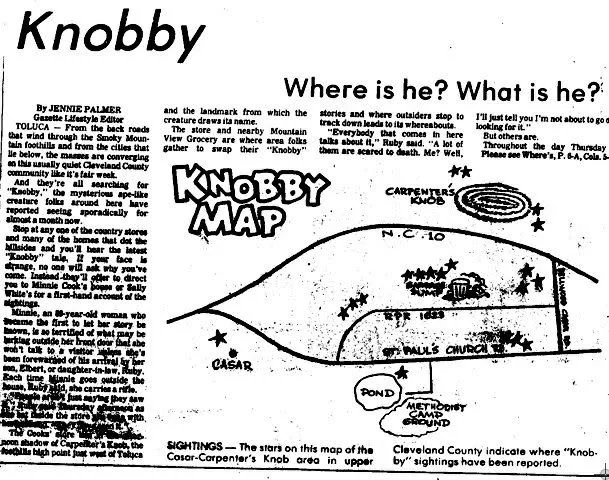
A map of supposed Knobby sightings as shown in a contemporary newspaper report
This particular Sasquatch lives in territory centered on a location called Carpenter’s Knob in Cleveland County, from which the creature gets its name. It is not much different from other Bigfoot-type creatures and is honestly rather on the short side compared with others of its ilk, being six feet tall, 200 pounds, and having a small head with a dark, flat face. The biggest distinguishing feature, however, appears to be its blonde hair, which is not unheard of in Bigfoot reports, but certainly less common than darker colors.
Sightings seem to date back to November 1971, when a local hunter claimed to have seen a creature resembling a bear walking on its hind legs on a ridge near Butler Knob for longer than should have been possible for a black bear. He reported seeing it fiddle with a tree branch and then disappear over the other side.
What really cemented Knobby’s place in the cryptozoological canon, however, was the wave of sightings that started in January 1979, in which the creature was repeatedly spotted rambling through the trees alongside local highways and digging through dumpsters, looking for food. It was also described as uttering terrifying noises that ranged anywhere from a deep growl to a scream like that of a woman getting murdered to even what sounded like yodeling. At least one local farmer accused it of breaking his goat’s neck and killing it.
As the sightings died down, many skeptics proposed that Knobby was anything from a bear to a panther to an escaped carnival baboon to a prankster in a gorilla suit. Still, sightings of the blonde Bigfoot have continued in the 21st century. One especially dramatic encounter was reported by Casar resident Tim Peeler on June 5, 2010, who claimed he was woken up at 3 a.m. when his dogs started howling. He went outside to investigate and was startled to see a ten-foot-tall, ape-like creature with light, shaggy fur making its way toward the dog pen. Luckily, Peeler scared the creature away by yelling at it and beating it with a large stick. His story made national news, to the point that Jimmy Fallon even joked about it on his talk show.
True to form for many cryptid-haunted small towns, Cleveland County residents have found many ways to capitalize on their nebulous neighbor. These include Knobby-themed sandwiches, bumper stickers, T-shirts, and even bus tours showing where the most prominent sightings have occurred. Knobby has also become the mascot of Cleveland County Community College, and Casar Elementary School hosts an annual marathon fundraiser in its honor. Clearly, the residents of Cleveland County really don’t seem to mind this anomalous drifter.
Lorelai of the French Broad River
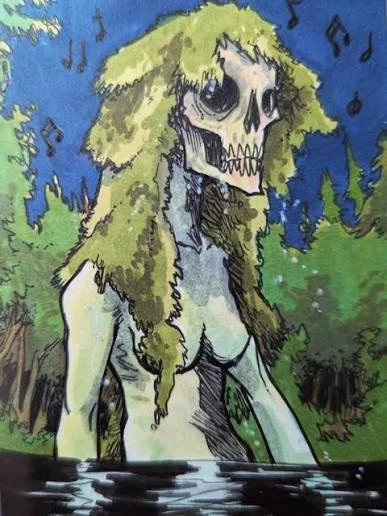
Artist credit: ironclownstudios on Instagram
The name “Lorelei” is better known to folklorists for its association with the famous rock formation along the Rhine River in Germany, said to be home to a siren because of its unique acoustic properties and the unusually high number of shipwrecks in its shadow. If Appalachian folklore is to be believed, however, a similar entity lurks in the French Broad River, which runs alongside Asheville and Knoxville as it meanders to the Tennessee River.
Here’s how the legendary folklorist Charles M. Skinner described the legend in his seminal 1896 work Myths and Legends of Our Own Land:
Among the rocks east of Asheville, North Carolina, lives the Lorelei of the French Broad River. This stream—the Tselica of the Indians—contains in its upper reaches many pools where the rapid water whirls and deepens, and where the traveller likes to pause in the heats of afternoon and drink and bathe. Here, from the time when the Cherokees occupied the country, has lived the siren, and if one who is weary and downcast sits beside the stream or utters a wish to rest in it, he becomes conscious of a soft and exquisite music blending with the plash of the wave.
Looking down in surprise he sees—at first faintly, then with distinctness—the form of a beautiful woman, with hair streaming like moss and dark eyes looking into his, luring him with a power he cannot resist. His breath grows short, his gaze is fixed, mechanically he rises, steps to the brink, and lurches forward into the river. The arms that catch him are slimy and cold as serpents; the face that stares into his is a grinning skull. A loud, chattering laugh rings through the wilderness, and all is still again.
Several sources say the legend first appeared in print in the 1845 poem “T’zelica: A Tradition of the French Broad” by William Gilmore Simms. I have no idea whether this siren actually comes from Cherokee folklore, though, and Wikipedia describes Simms as fiercely pro-slavery, so I’m not sure he can be counted on as a reliable source.
While one may except a story like this to remain in the more credulous times of the 19th century, the Pine Barrens Institute has recorded a supposed eyewitness sighting from the region. A man known only as “Guard” claims he snuck out of his house with his girlfriend in the summer of 2011, when he was fifteen, and set up camp along the riverbank. He went out at 3 a.m. to answer a call of nature and was startled to see a man on the opposite shore casually wading in, staring intently at the water’s surface. When the water reached groin height, he dove in. Guard stood watching for a few more minutes, getting more and more unnerved as the man failed to resurface, until he finally retreated to the safety of his tent. He claims to have been plagued by nightmares in which he walked down to the water and saw a woman in the place of his reflection, which left him with crippling thalassophobia and PTSD so bad he had to seek therapy and get medicated for it.
So remember: if you’re walking along the French Broad River and you hear a woman singing with no obvious source, get the hell away from there!
The Maco Light
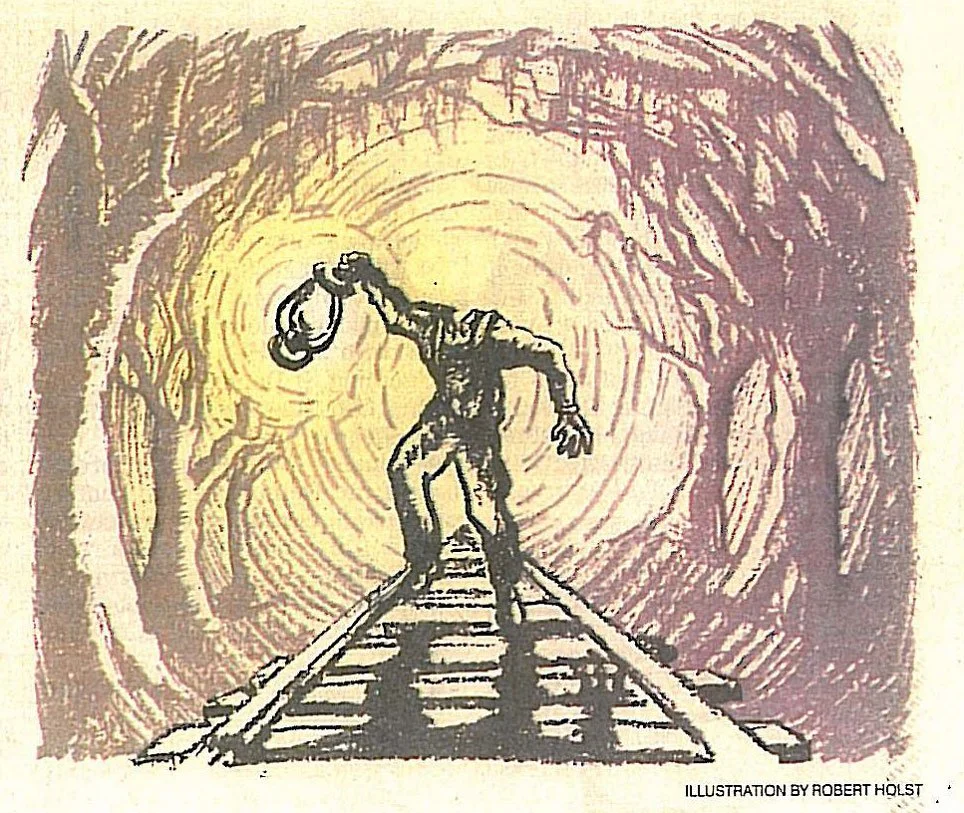
It turns out that the Brown Mountain lights aren’t the only “ghost lights” reported in North Carolina. This light comes from Brunswick County at the extreme southern end of the state, and revolves around a train conductor who died in a horrible accident and still patrols the tracks for reasons known only to him.
The legend claims that Joe Baldwin was working his usual beat on the Wilmington and Manchester Railroad on a rainy night in 1867 when the caboose he was riding on separated from the rest of the train. Baldwin frantically tried to signal the next train on the line with his lantern, but the engineer didn’t see it in time. When the crews were finished digging through the rubble, Baldwin’s body was discovered, but his head was never found, likely having been swallowed by the nearby swamp.
Locals soon began to notice a strange light floating beside the tracks at night, variously colored white, red, or green, usually drifting across the tracks about five feet off the ground. It was reportedly bright enough to make train engineers stop their locomotives, confused as to the mixed signals they were getting. This is even said to have happened to a train carrying President Grover Cleveland in 1889, at least according to Atlantic Coast Line employee B.M. Jones, who was a child at the time. Locals widely agreed that it was Joe Baldwin’s ghost, returned from the grave and searching for his missing head. Others, like the famous parapsychologist Hans Holzer (who personally investigated the phenomenon in 1964), argued that Baldwin did not realize he was dead and was thus continuing to do his job even a century after his death.
It should be noted that official records do not indicate that there was ever an accident involving anyone named Joe Baldwin on the Wilmington and Manchester line. However, there are records of a Charles Baldwin who died in January 1856 when a locomotive being recoupled with its cars came in too fast, which was blamed on Baldwin neglecting to hang a lamp to alert the engineer. Charles was not decapitated and initially survived the incident, only to later succumb to his injuries at the hospital.
In addition, there have been several non-supernatural explanations proposed for the light’s origin. Some locals argued that the light was nothing more than phosphorescent swamp gas, while others argued that it was the result of automobile headlight reflections. In any case, the lights stopped appearing in 1977 when the Wilmington-Manchester railroad was removed. Nevertheless, the legend is still commemorated by a street called Joe Baldwin Drive in the nearby town of Sandy Creek.
The Mermaids of Cape Fear River
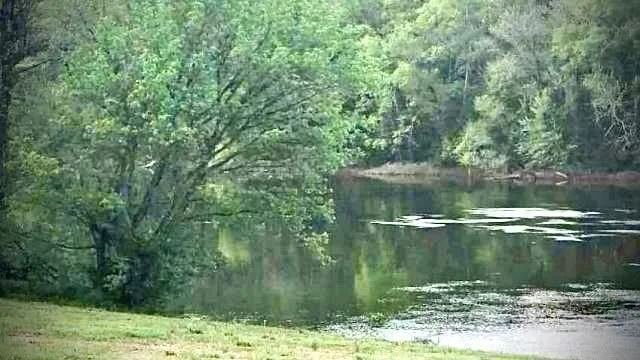
Mermaid Point as it appears today (© WRAL)
French Broad isn’t the only North Carolina river to host piscine humanoids, as it turns out. Another spot on the Cape Fear River is said to have been home to mermaids during the American Revolution. Interestingly, though, this spot was nowhere near the ocean. Instead, it was located in Chatham County, almost in the dead center of the state, where the Deep and Haw Rivers converge to form the Cape Fear.
The legend centers on Ramsey’s Tavern in the hamlet of Lockville (now resting within the town of Moncure), which sat on the bank of the Deep River just upstream from the spot now known as Mermaid Point. During the Revolution, it was home to a large sandbar, and it was there that soldiers out to calm their nerves with a generous dose of liquor would report seeing mermaids whenever they drunkenly stumbled back into the outside world.
The soldiers reported seeing the mermaids laughing, frolicking in the water, singing, and combing their hair. It was theorized that they traveled so far from the ocean because they wanted to wash the sea salt out of their hair. Unlike their French Broad cousin, though, they seemed to show no predatory behavior toward the drunken soldiers. Indeed, if they ever noticed that anyone was spying on them, they would dive back into the water.
Of course, given how heavily alcohol is involved in this story (as well as the fact that the Revolution was a very stressful time in American history), it’s very easy to conclude that these mermaids rested more in the minds of their inebriated witnesses than they did in the real world. And even in the unlikely event that real-life mermaids actually did reside on the Mermaid Point sandbar, they are most certainly no longer there, as the sandbar was submerged due to damming, which also would have likely obstructed the mermaids’ path back to the spot. Ramsey’s Tavern is also gone, having been swept away by a flood in the 1800s.
The Moon-Eyed People of Appalachia

Artist credit: Ballyraven on Teepublic
Untangling the lore behind these diminutive humanoid creatures (with territory centered in the area between the Little Tennessee and Hiwasse Rivers) is somewhat complicated, as they appear to be a creation of Cherokee folklore that was co-opted by white settlers seizing upon their supposedly white skin to claim that the Cherokee chased older white settlers out of their valley centuries before, and therefore they were totally justified in sending them away on the Trail of Tears. Suffice it to say, there’s a lot to unpack with this legend.
The stories of the moon-eyed people appear to have first circulated among white settlers in Cherokee territory in the late 18th century. John Sevier, who would later serve as Tennessee’s first governor between 1803 and 1809, claimed that the great Cherokee chief Oconostota introduced him to an ancient ruin on Fort Mountain in Georgia in 1782. Sevier claimed that the chief described the ruin (a zigzagging wall) as the last remnants of a fort built by “white men from across the great water.” Fifteen years later, naturalist Benjamin Smith Barton, writing in his book New Views of the Origins of the Tribes and Nations of America, was the first to describe these people as “moon-eyed,” in reference to their supposed inability to tolerate the daytime sun or full moon nights. He described them as an albino race and compared them to the indigenous Guna people of Panama and Colombia, who have an exceptionally high rate of albinism among their populace. He also described them as being forcibly expelled by the Cherokee in a battle at Fort Mountain many years before Europeans first came to the area.
Incidentally, Barton cited Welsh explorer and buccaneer Lionel Wafer’s descriptions of the Guna, which is surprisingly only the start of the Welsh people’s long association with the moon-eyed people. They quickly became associated with the legend of Prince Madoc, a legendary Welsh explorer who is said to have landed on American shores in 1170 and established a fort at a site called Devil’s Backbone on the Ohio River near the future site of Louisville, Kentucky. His crew is said to have intermarried with the natives and produced a group of Welsh-speaking Indians. The legend became so popular that President Thomas Jefferson even instructed the Lewis and Clark Expedition to look for evidence of “Welsh Indians.” Neither they nor any other expedition has ever found any evidence of their existence. Folklorist Peter Stevenson has argued that the Welsh may have become associated with the term “moon-eyed people” because many Welsh miners descended upon Cherokee country in the 18th century, in reference to their apparent ability to see in the dark of their many mineshafts.
Nowadays, though, it is largely agreed that the Fort Mountain wall dates to the Middle Woodland Period (100 BCE-500 CE) and may have been built by migrants from the Adena people in the Ohio River Valley. A soapstone statue supposedly depicting a pair of moon-eyed people is currently housed in the Cherokee County Historical Museum, which was discovered by local farmer Felix Ashley in the 1840s. Some sources claim the statue is 2,000 years old, which is doubtful, considering that soapstone is only a 1 on the Mohs scale and thus very susceptible to erosion.
Several people, both within and without the Cherokee community, have connected the moon-eyed people to a group of fae-like beings called the Yunwi Tsunsdi (meaning “little people” in the Cherokee language). They were somewhat less friendly than the Nunnehi, prone to harshly punishing anyone who disrespected them, and the Cherokee were scared enough to warn their children not to go looking for them and to ignore them if they ever heard the little people moving around outside at night. Cherokee folklorist Lynn Lossiah writes that the Yunwi Tsunsdi would punish people who tried to take knives they found in the woods by pelting them with stones unless they asked the little people for permission to take it. Meanwhile, Reddit user kissmybunniebutt (an Eastern Band Cherokee) commented on this post about the moon-eyed people on r/IndianCountry, claiming that the little people existed mainly as boogeymen to keep children from wandering into dangerous situations in the wilderness, especially at night.
Eerily, another Redditor commented on this post on r/Appalachia about strange experiences he and a friend had at a 160+ year old cabin in Jackson County, not far from the petroglyph-bearing Judaculla Rock. They claim their friend heard ringing bells outside the cabin that he couldn’t pinpoint the location of while he was staying the night, and also noted a couple of incidents where his truck’s passenger-side mirror was moved out of position when he wasn’t looking.
Is it possible that the little people are still lurking in their old territory? Who knows?
Normie

Lake Norman, located in the southwest region of the state, is the largest freshwater body in the entire state. Created between 1959 and 1964 by the construction of the Cowans Ford Dam, the reservoir has since become a major hub for tourism and infrastructure, providing drinking water to surrounding municipalities and cooling water for local nuclear and coal-burning power plants. It also seems to have become the chosen home of North Carolina’s resident Loch Ness Monster analog, if local legends are to be believed.
There doesn’t appear to be much consensus on what the mysterious creature affectionately dubbed “Normie” actually looks like, though. Some descriptions make it out to be a classic sea serpent type, while others describe it as resembling an oversized alligator. It seems to exhibit signs of curious around humans as they swim and play in the lake, often chasing speedboats and sometimes brushing up against swimmers. Attacks are rare but not unheard of. A scuba diver claimed that a creature with a dog-like head and red eyes grabbed onto one of his flippers while he explored the lake, forcing him to kick the flipper off to free himself.
Many theories have been proposed to explain these strange sightings. The aforementioned nuclear power plant, McGuire Nuclear Station, has been accused of leaking nuclear waste into the lake, which caused one of the animals to mutate. Indeed, one witness who claimed that Normie brushed against him while he was jet-skiing said the monster left a slime on his leg that left him with an itchy rash. Of course, there are plenty of less fanciful explanations available, from optical illusions and floating logs to a host of animals actually endemic to the lake, like large catfish swimming around the deep end of the lake at the dam to so called “daisy chains” of gar, in which as many as 20 male fish follow a spawning female, which can create the illusion of a bigger animal. There is also the testimony of a commenter on this post on r/Charlotte who claims that the guy who runs Normie’s official website basically started the stories on his own by exaggerating stories of large fish found in the lake and its surrounding rivers so he could sell T-shirts and other merchandise.
While most comments on the Reddit post joke about actually seeing Normie, there are a few from people who claim to have genuinely seen something in the lake that they can’t explain. Captain Dinosaur claims to have seen a 15-25 foot creature that wasn’t a fish, with eyes “the size of the bottom of a Duke’s mayonnaise jar,” which pulled a life preserver under the water, never to be seen again. KahlessAndMolor recounted a dramatic story in which he and a friend were caught in the middle of the lake during a thunderstorm, during which they saw a creature they described as a whale the size of an alligator, which breached the surface with its back and displayed a tail that was “wide like a fish, but seemed more firm like a seal” as it dove. Of course, the witness also says his friend was so shocked he dropped his beer into the lake, so maybe take this story with a grain of salt.
Of course, if you have a sighting to share, feel free to submit it to Normie’s official website. Maybe you just saw an unusually large catfish, but you never know, right?
The Santer
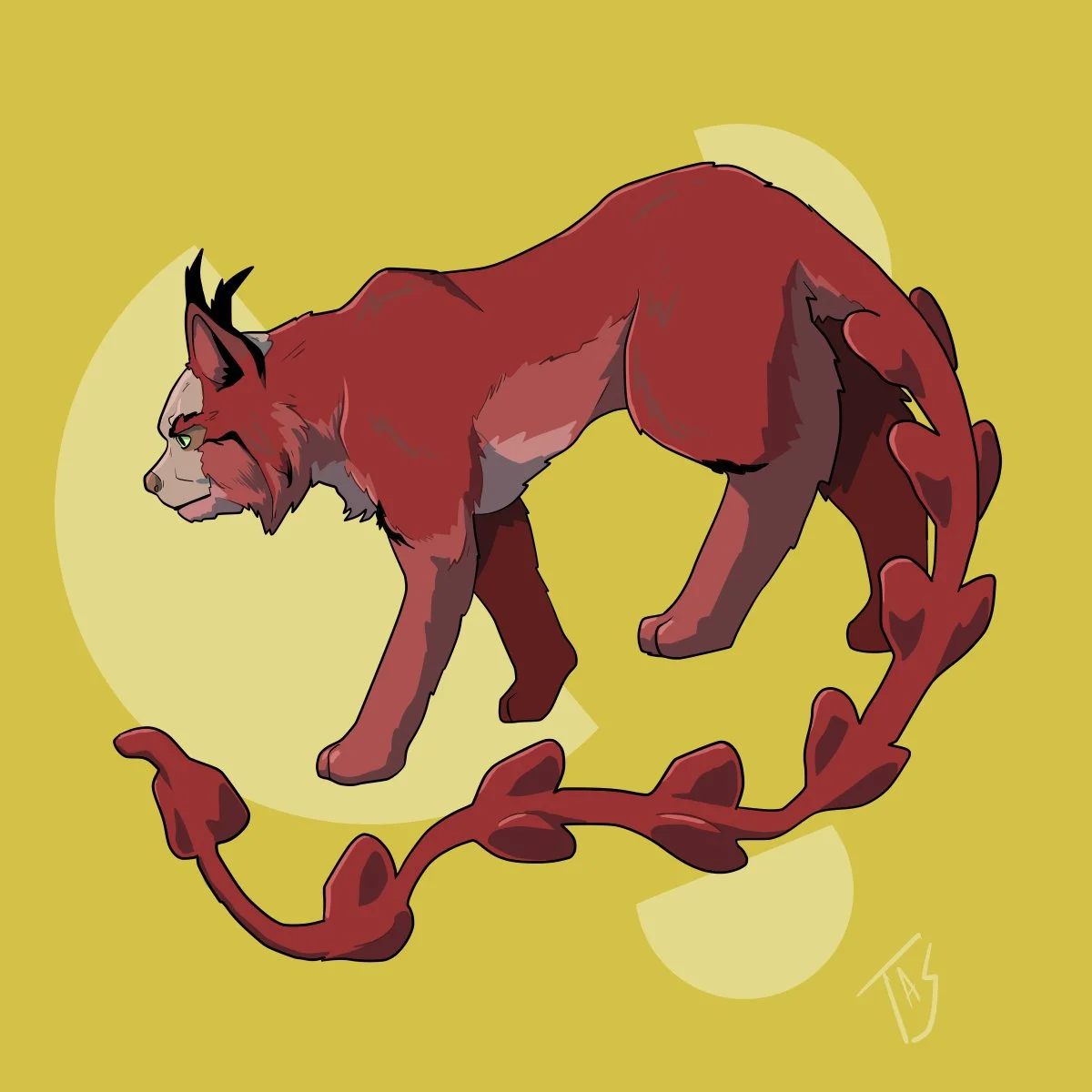
Image source: The Compendium of Arcane Beasts and Critters
This fearsome feline appears to be North Carolina’s answer to the Wampus Cat. Said to lurk in the mountains of the West, it has been described as having reddish-grey hair, a large, bald head with small eyes, long legs, and an even longer tail. Its biggest distinguishing feature is the eight knobs spread along the length of the tail, which it uses as a clubbing weapon, and can apparently strike with enough force to singe the hide of any animal unlucky enough to come within striking distance. It can move remarkably fast, and utters a cry similar to a wailing infant. It has never been reported to attack humans, although it is notorious for its livestock-killing sprees.
While such an animal sounds too preposterous to exist anywhere outside of lumberjack campfire stories, there are news reports from people who claim to have seen the Santer, mostly from the 1890s. It was blamed for seven dead pigs and fifteen dead cows in September 1890 and was shot at by a police officer when it went after his dog. The following month, a possum hunter claimed that it scared his dogs with its howling, while two local widows claimed it reared up against their back door and growled at them. Local witness Adam Lentz claimed it was almost as big as a cow.
The Santer seemed to vanish from the newspapers until March 1897, when it was spotted along the shore of the Roaring River and blamed for local cat and dog deaths. It was reported captured in June of that year and was claimed to resemble a large shepherd dog. It nevertheless resurfaced in May 1899 and reportedly killed a dozen chickens. A female witness claimed it had grey hair and was halfway between a cat and dog in size. Sightings would continue to trickle out of the region until petering out in the 1920s.
The full story details can be found in this post on r/UnresolvedMysteries, along with several theories as to the creature’s true identity. Some say it was an eastern cougar, while others say it was a fisher (a mustelid that used to be endemic to the North Carolina Appalachians until the fur trade wiped them out from everywhere south of the Catskills), or a lynx (which was never endemic to NC), or a newspaper hoax, or some combination of all of them. Other commenters noticed a troubling detail that claimed the Santer was fond of preying on black babies, which could indicate that whites in the Jim Crow South had adopted it as a boogeyman to scare superstitious black people (similar to the Snallygaster, as discussed in the Maryland article).
Tsul ‘Kalu
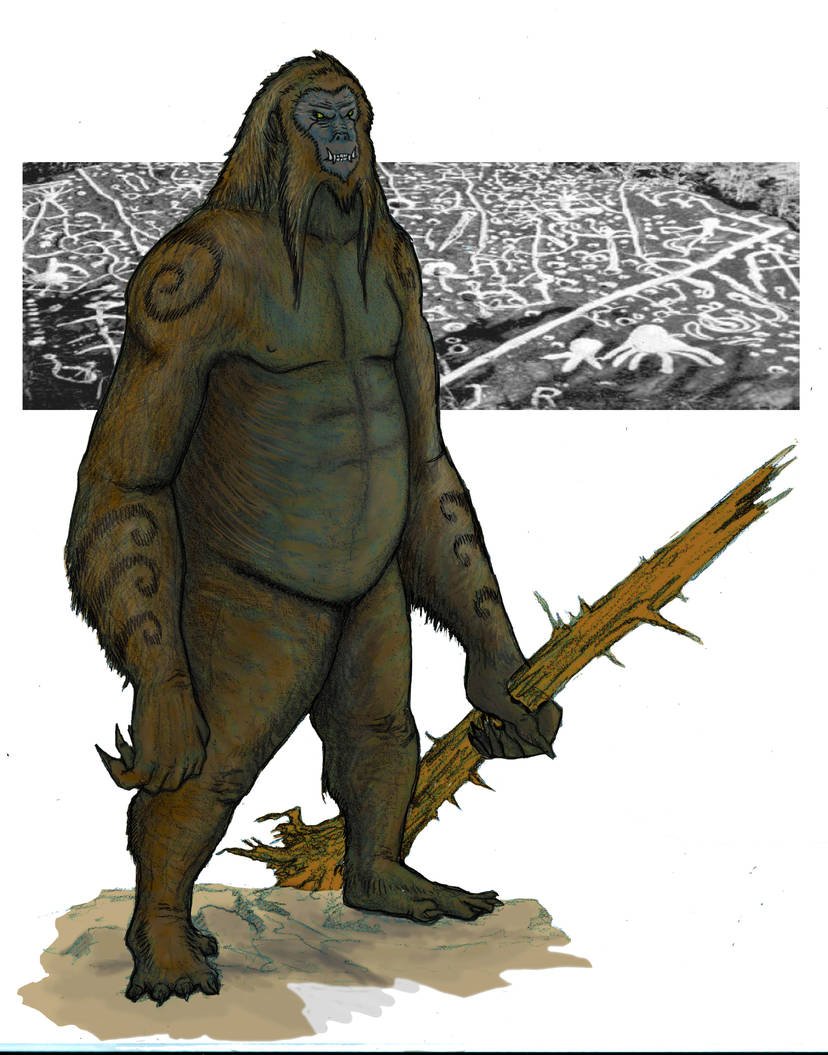
Artist credit: Ashere on DeviantArt
One of the best-known Cherokee legends, this giant got his name (which means “he has them slanted”) from his slanted eyes, which flashed like lightning when he was angry. He served as the Cherokee god of the hunt, similar to the Greek Artemis or the Celtic Cernunnos, whose name hunters would invoke in rituals to ensure a safe and successful hunt. He was said to look after the region’s plants, animals, and water until the Cherokee’s arrival, upon which he took it upon himself to teach them how to look after the land. T.J. Holland, the Eastern Band’s cultural resources supervisor, has even gone as far as to call him the first forest ranger of the Appalachians.
Tsul ‘Kalu’s name has also been Anglicized to Judaculla, and he is indeed the inspiration for the famous Judaculla Rock in Jackson County, which is said to have gained its famous petroglyphs after Tsul ‘Kalu grabbed it to steady himself after jumping off a mountaintop, scratching it with his fingernails in the process. It subsequently became a popular spot for Cherokee hunters to pay tribute to him up until their forced removal in the 1830s. Other locations associated with the giant include Tanasee Bald (also in Jackson County), where he was said to make his home, and Tsula’sinun’yi, a spot in Swain County a mile above where Deep Creek empties into the Tuckasegee River, said to preserve his footprints.
There came a time when Tsul ‘Kalu had to leave Cherokee territory, although the reason why varies depending on the retelling. Some say he had simply finished teaching the Cherokee all they needed to know and that he headed out west for greener pastures. Another popular folk tale (recounted in full on the giant’s World History Encyclopedia page) says he became smitten with a young woman living in the village of Kanuga (located on the banks of Pigeon River) and kept leaving her gifts. He would come in the dark and leave before sunrise, afraid his appearance would frighten the girl and her mother. When the girl demanded he finally show himself, he stayed in the âsï (a small winter house smaller than the traditional family lodge) until morning, revealing himself to be a giant so large that he was “lying doubled up on the floor, with his head against the rafters in the left-hand corner at the back, and his toes scraping the roof in the right-hand corner by the door.” Tsul ‘Kalu became angry at their frightened reaction, and left for his home. Shortly afterward, though, the girl had a baby, and when her mother tried to drown it in the river, Tsul ‘Kalu invited the girl to stay with him on Tanasee Bald. However, her older brother took it upon himself to track her down and bring her back to the village. Tsul ‘Kalu promised to show himself if the brother and the other men of the village fasted in the townhouse for seven days and did not raise the war whoop. When one warrior lost his nerve on the seventh morning and raised the war whoop, a great roar exploded out of the mountain and faded away into the west, leaving the Cherokee behind forever.
It is probably no surprise that modern-day cryptozoologists have attempted to connect Tsul ‘Kalu with Bigfoot. At least one Cherokee man going by the Reddit username Pomeiipat seems to agree, as he made a post on r/BackwoodsCreepy recounting how he and his malamute dogs were frightened by a loud howling noise outside his cabin near Rist Canyon in the Colorado Rockies. It resembled nothing from the local wildlife that he was familiar with, and when a police officer who answered his 911 call arrived on the scene, she was spooked enough by the sound to call for backup. He later recalls being astonished when he watched a Bigfoot documentary and heard a sound remarkably similar to the one he heard at the cabin coming out of the TV.
The Cryptid Wiki has also attempted to link the Knobby sightings (including the infamous Tim Peeler sighting) with Tsul ‘Kalu, albeit less successfully in my opinion.
The Wilmington Sea Serpent
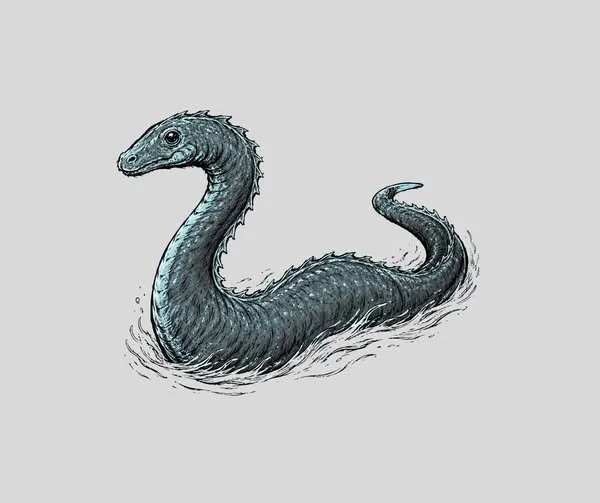
Image source: The State You’re In on Facebook
Often known by the affectionate nickname “Willie,” this aquatic anomaly has reportedly been spotted in the southern reaches of the Cape Fear River and in the ocean water surrounding the delta at Cape Fear. Some even claim that the serpent has been spotted in the area since Native Americans still lived there, and indeed, horned serpents are a common monster in Indigenous folklore across the eastern half of the US (I almost wanted to bring up Uktena from Cherokee mythology, but Cape Fear was more in Lumbee and Catawba territory).
What is certain is that stories of Willie go back all the way to when European explorers first came to North Carolina’s shores. When Giovanni da Verrazano first arrived in the Cape Fear region in 1524, the crew of his ship reported seeing a large, scaly, snake-like being resting near the shore as the ship sailed up the Cape Fear River. Another early sighting is said to have been reported by the Earl of Wilmington in 1732, who claimed to see a long snake-like creature winding through the waves at the river’s outlet. Whether or not this Earl is referring to Spencer Compton, the future second Prime Minister of England, is something I have been unable to ascertain.
Some sources claim this serpent first gained the name Willie in 1865, when Union soldier and naturalist James Calden wrote about sightings of a snake 40 feet long and 4 feet wide that had been repeatedly spotted in the area. Others claim the name came in 1903 after crew members of the SS Tresco reported seeing a large sea monster chase a group of sharks. Later, in 1947, the Santa Clara III reported a collision with an animal with a long, thick, dark-colored body.
Some paleontologists say the creature most resembles Basilosaurus, a large predatory ancestor of modern whales that could grow to 66 feet and went extinct 34 million years ago. Local historian Tabbot Cruthfield has even had an exhibit dedicated to Willie set up in the Wilmington Historical Museum, and as of 2000, a webcam was set up 100 feet upriver from the Cape Fear delta to watch out for the serpent. The camera may have caught something on June 21st, 2000, when the Bascom family was out fishing and the father, Nathan, claimed to have had his fishing rod yanked out of his hands by a creature he didn’t see. However, the camera caught something splashing around in the water at the time of the sighting. It’s a little too vague to say whether it’s something unknown to science, though.
And another state done and another state done and another one bites the dust… (please do not read any genocidal intent into the above statement. It’s just a dumb joke to end things on.)
Don’t expect another one of these until after New Year’s, because I have a lot of animation-related projects to check off my list, including the first half of the 2025 series list (January-June) and the second 1001 Animations Halloween special. I might end up making three 1001 lists before the end of the year, including the second Christmas special and possibly a non-holiday-themed one in November. I think I’ll save the details for a dedicated update post, because I’ve also had a rather eventful September as far as IRL stuff goes, and I don’t think I can fit it all into the postscript of a “Cryptids” article. Keep an eye out for that within the next day or two, along with the first half of the “Best Animated TV Shows of 2025” list, which should be coming out in the next two weeks.
Until then, stay safe, stay away from any especially dark and misty Appalachian hollers, and I’ll see you all again very, very soon, I hope.