The 1001 Animations You Must See Before You Die #41-50
Welcome back to the fifth episode of my overly ambitious attempt to create a 1001 Movies/TV Shows/Albums/Books, etc. You Must See/Listen To/Read Before You Die list for the art of animation (non-holiday edition).
This entry gives us a lot of firsts for this series: the first Tom and Jerry short, the first French film, the first Chinese film, the first Makoto Shinkai film, and the first (and probably only) Illumination film. We’ll also be tackling our second film starring the Peanuts gang, a PBS film set to a classical theatrical work about a deal with the Devil, a 90s cult classic using cute talking animals as a metaphor for racism, one of the first anime series to make extensive use of CGI, and an anime fantasy epic that may end up making you want to call your mother and tell her you love her.
I’ve explained elsewhere how this series works, so I won’t waste any more time on introductions. Let’s jump right in!
#80: The Yankee Doodle Mouse
Animation style: Traditional 2D
Release date: June 26, 1943
Distributor: Metro-Goldwyn-Mayer
Production company: MGM Cartoons
Directors: William Hanna, Joseph Barbera
Writer: Cal Howard
Producer: Fred Quimby
Music: Scott Bradley
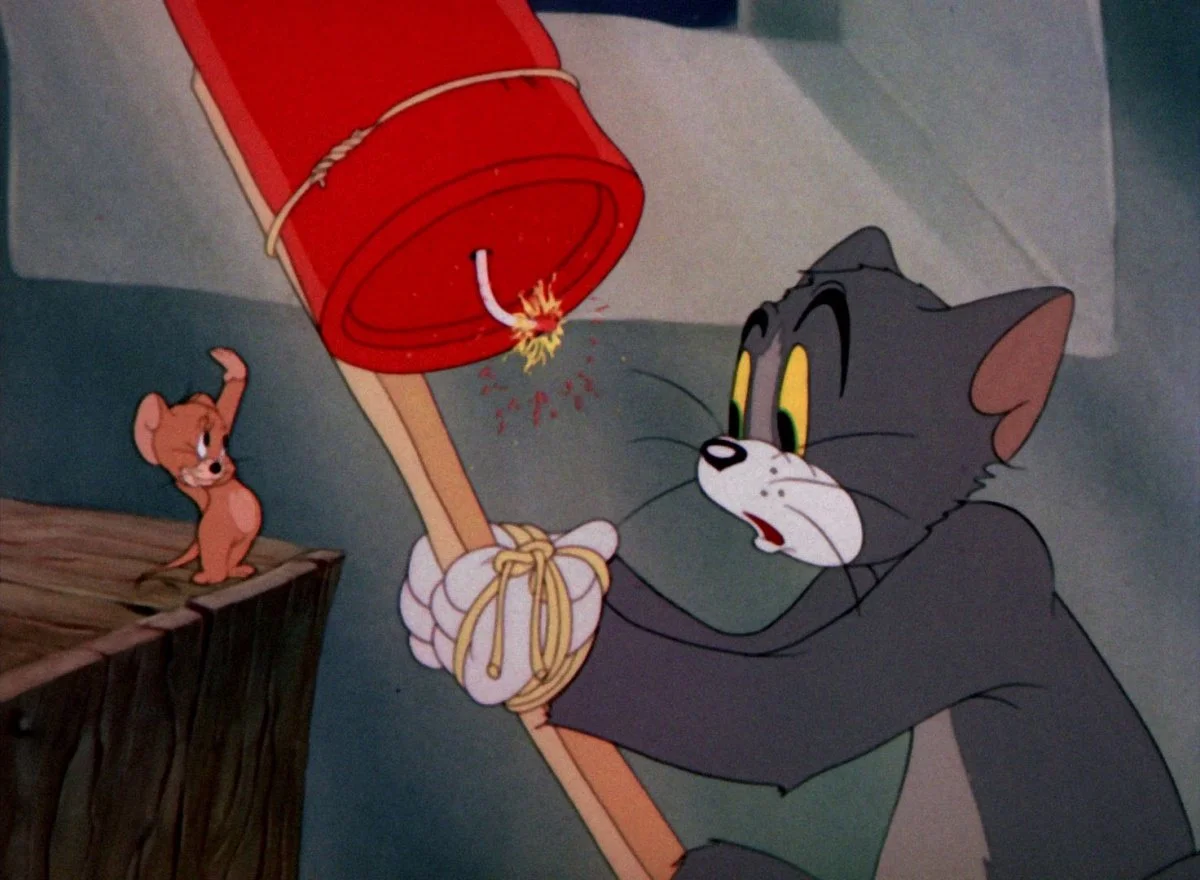
The 11th Tom and Jerry short ever produced (and the first out of seven to win the Oscar for Best Animated Short Film), this is the titular duo’s contribution to the so-called “Wartime Cartoons” canon, although it goes about it in a more subtle way than Der Führer’s Face or Reason and Emotion.
It doesn’t differ much from the usual formula of “Tom tries to catch Jerry; hilarious slapstick hijinks ensue.” Tom chases Jerry into the cellar, where the latter takes shelter in his mousehole (relabeled as his “Cat Raid Shelter”) and battles Tom with methods highly reminiscent of the ongoing world war. For instance, eggs become “hen grenades,” a milk carton gets repurposed into a fighter plane, and bananas are refashioned into torpedoes. The walls of Jerry’s mousehole are adorned with posters bearing slogans like “That friendly rat may tell the cat!” and “Shut your trap!” Several famous war communiques of the era are also referenced. When Jerry sinks a pot Tom is using as a flotation device in a washtub, he writes “Sighted cat. Sank same,” a reference to the common American airman signal “Sighted sub. Sank same.” Jerry’s request, “Send more cats,” after defeating Tom for good, is a reference to a message allegedly sent by Marines who repelled a Japanese attempt to invade Wake Island on December 11, 1941, despite being massively outnumbered.
Aside from the whole “wartime novelty” aspect, the short is probably best remembered today for being one of the first Tom and Jerry shorts to really lean into the violence of Tom and Jerry’s rivalry (it is based on World War II, so it’s probably not that surprising). Jerry attacks Tom with champagne corks, light bulbs, and even a cheese grater attached to a roller skate at one point, and the short even ends with Jerry tricking Tom into tying himself to a firework. Overall, it seems less like Tom wants to catch Jerry and eat him and more like he just wants to kill him outright.
The short is also less fondly remembered for a scene in which Tom sticks his head into a teapot with a lit firecracker inside, which explodes, leaving him looking like a blackface sunflower. I suspect this is the reason I wasn’t able to find the short on Tom and Jerry’s current streaming home, Tubi (I had to turn to a third-party upload on Dailymotion instead). There are some memorable gags in the short that don’t make you feel uncomfortable, though, like the “Matroyska firecracker” gag (which Tom finds out the hard way isn’t quite as harmless as it looks).
Some may not find The Yankee Doodle Mouse quite as memorable as other Tom and Jerry shorts, like Mouse Trouble or Blue Cat Blues. Still, as the first Oscar winner of the bunch, it proved that this charmingly vitriolic duo had a bright future ahead of them.
#174: Havoc in Heaven
Animation style: Traditional 2D
Release date: 1961 (Part 1); 1964 (Part 2)
Production company: Shanghai Animation Film Studio
Director: Wan Laiming
Writers: Wan Laiming, Li Keruo (based on the novel Journey to the West by Wu Cheng’en)
Producers: Wan Laiming, Wan Guchan, Wan Chaochen, Wan Dihuan
Music: Wu Yingju
Over two decades after the Wan brothers singlehandedly started the Chinese animation industry with their 1941 feature Princess Iron Fan, they successfully braved the political volatility that plagued their country in the mid-20th century to produce their second film based on the classic novel Journey to the West.
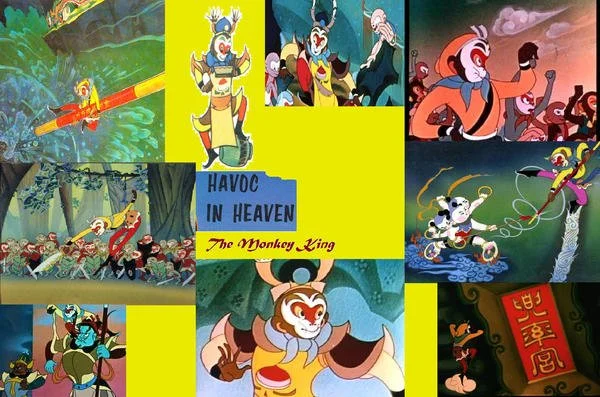
Based on the novel’s opening chapters, the film follows the Monkey King, Sun Wukong (Qiu Yuefeng), who, in his quest to find a worthy weapon, steals the magic staff Ruyi Jingu Bang from Ao Guang (Ke Bi/Chen Kaige), the Dragon King of the Eastern Sea. Word of his theft eventually reaches the Jade Emperor (Fu Runsheng) on his throne in Heaven, and he immediately schemes to get the unruly simian under control. However, the Monkey King keeps finding ways to screw up Heaven’s plans for him. When he’s put in charge of the Heavenly Stables, he sets the mistreated horses free. When he learns he was not invited to the gods’ Peach Banquet, he steals all the food and takes it back to his people on Mount Huaguo. Tired of his antics, the Jade Emperor sends several of his best warriors, like General Li Jing, Nezha, and the Four Heavenly Kings, to vanquish the Monkey King once and for all. But they may find that Sun Wukong is a little too crafty and headstrong to stay down for long…
Havoc in Heaven is one of those movies where the production history is just as interesting as the film itself (which is discussed in detail in this The China Project article). The Wan brothers had started planning the film shortly after Princess Iron Fan was released, but were forced to put it on hold thanks to the Japanese invasion and their studio executives deciding they could make a much better profit by selling off the film equipment rather than making an actual film. The brothers bounced all across China doing odd jobs until 1954, when things had finally settled down long enough for the Shanghai Animation Film Studio to be established, giving them a place to start the project in earnest. While Havoc in Heaven was highly acclaimed upon its release, it wasn’t well received by China’s communist government, which viewed it as anti-Maoist propaganda. Things went from bad to worse when the Cultural Revolution began in 1966, causing SAFS to close its doors for the next decade and plunging the nascent Chinese animation industry into dormancy. Nevertheless, the film has become an enduring classic among the Chinese, to the point that its Chinese title, Da Nao Tian Gong, has become a widely used slang term for somebody making a mess.
Having watched Havoc in Heaven myself, I can definitely see why it’s so beloved across the pond. The animation is expertly crafted, with lively action scenes and bright colors that pay excellent tribute to classical Chinese art. The voice cast is great, with Qiu Yuefeng’s performance as Sun Wukong being so iconic that his high-pitched smart-aleck delivery has become the Monkey King voice. It probably helps that he gets a major personality overhaul in this retelling, going from the impulsive and borderline sociopathic trickster he was in the original novel to a conscientious and principled rebel against the heavenly hierarchy, thus echoing China’s then-recent communist revolution. The Peking Opera-inspired music also deserves mention, especially for how it uses percussive effects to replace traditional sound effects during the battle scenes.
Probably the only negative thing I can say about the film is how happily it ends. If you’ve read Journey to the West (or have watched Red’s recap of the series on the YouTube channel Overly Sarcastic Productions, as I have), then you would know that Sun Wukong’s war against the heavens actually ends with him being imprisoned under a mountain for 500 years. Then again, given the Monkey King’s heroic makeover, this could be entirely irrelevant.
Despite this quibble, I wholeheartedly recommend Havoc in Heaven for anyone who even remotely cares about animation. Even if you hate the Chinese government with every fiber of your being, it’s still good to get a little taste of their culture every now and again, especially if it’s this well animated!
#230: A Boy Named Charlie Brown
Animation style: Traditional 2D
Release date: December 4, 1969
Distributor: National General Pictures
Production companies: Cinema Center Films, Lee Mendelson/Bill Melendez Productions, United Feature Syndicate
Director: Bill Melendez
Writer: Charles M. Schulz (based on his comic strip Peanuts)
Producer: Lee Mendelson
Music: Vince Guaraldi
We already covered the second feature film starring the Peanuts gang in the first episode I ever did for this series. Now, let us examine the gang’s first foray onto the silver screen.
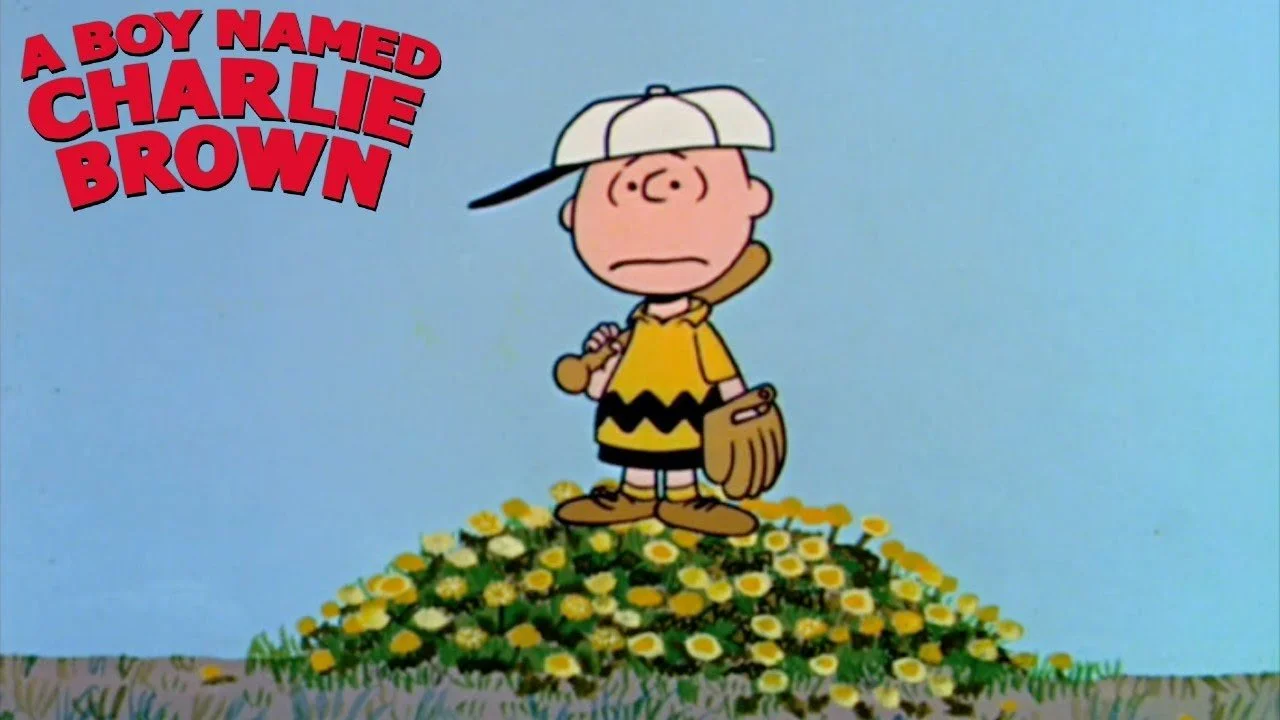
The first half follows Charlie Brown (Peter Robbins) as life seems to give him one kick in the teeth after another. He gets no respect from his peers, especially when his team loses the first baseball game of the season, and when Lucy Van Pelt (Pamelyn Ferdin) yet again steals the football away from him just as he’s about to kick it. When Lucy mockingly suggests he join the school spelling bee, however, Charlie sees an opportunity to win his classmate’s respect. But then he becomes filled with self-doubt again when he makes it to the National Spelling Bee in New York City. Can he manage to keep his anxiety in check long enough to win first prize?
The animation hasn’t changed much from the limited style of the TV specials, but that’s probably for the best, as the uniquely down-to-earth atmosphere of the Peanuts universe would likely be lost if the characters were moving like they were in a Disney movie. There are some sequences where the animation does get a little more creative, like during Snoopy’s (Bill Melendez) ice skating sequence or when the film abruptly turns into a Fantasia homage when Schroeder (Andy Pforsich) starts playing the second movement of Beethoven’s Sonata Pathetique on his toy piano. Granted, given that none of these scenes add anything to the plot, one could argue that they’re only there for the sake of padding out the runtime (even Bill Melendez admitted that was the sole reason he put the Beethoven sequence in the film). Even so, they’re still pretty to look at.
Speaking of Beethoven, I have to shout out the music as well. Vince Guaraldi made magnificent use of his expanded music budget to add electric guitar, horns, and an orchestra to the basic piano/drums/upright bass setup he used for the holiday specials. The result is just enough of an upgrade to make the music film quality, while still staying true to the laid-back sound of his previous scores. The soundtrack also includes four songs: the title song, written and performed by Rod McKuen (which could arguably work as a theme song for the entire Peanuts franchise); “Failure Face,” sung by Lucy and her friends to bully Charlie Brown (which is so over-the-top in its meanness that it loops right back around into hilarity); “I Before E,” sung by Charlie Brown as he practices for the spelling bee with Snoopy accompanying him on a mouth harp; and “Champion Charlie Brown,” which plays after Charlie wins the school spelling bee. The soundtrack even earned the film an Academy Award nomination for Best Original Song Score (which it lost to the Beatles documentary Let It Be).
The Peanuts characters themselves remain in fine form on the silver screen. Charlie Brown remains his usual depressive yet kind-hearted self; Lucy is still a bossy fussbudget; Snoopy is still a lovably imaginative trickster; and Linus is still paradoxically one of the most emotionally intelligent kids on the block, yet unable to part with his security blanket. In fact, Linus does part with his security blanket in this movie, giving it to Charlie Brown for good luck when the latter goes to NYC (that is, until he starts developing withdrawal symptoms and rushes back to NYC to get it back). Charlie’s relationship with Snoopy also gets an upgrade when Snoopy helps his master train for the spelling bee with the “I Before E” song, even coming to school during the bee to calm Charlie’s nerves by playing the song on his mouth harp. It’s a nice reminder of how much they care about one another despite how often they get on each other’s nerves.
Even though it came out at the tail end of the 60s, A Boy Named Charlie Brown still manages to be as timelessly charming as all of the best Peanuts screen adventures. Along with Snoopy Come Home and The Peanuts Movie, it’s one of the best big-screen outings the gang has ever had, especially with its ending message that screw-ups aren’t such a big deal, especially if you’re Charlie’s age.
#372: Great Performances: The Soldier’s Tale

Animation style: Traditional 2D
Release date: November 29, 1984
Distributor: WNET, PBS, MGM/UA Home Video
Production companies: R.O. Blechman Inc., WGBH
Directors: R.O. Blechman, Christian Blackwood (live-action sequences)
Writers: R.O. Blechman, Charles Ferdinand Ramuz (based on the theatrical symphony L’histoire du soldat by Igor Stravinsky)
Producers: Chloe Aaron, R.O. Blechman, George Griffin, Glenn Litton
Music: Igor Stravinsky (conducted by Gerard Schwarz and performed by the Los Angeles Chamber Orchestra)
This may be a musical tale involving a deal with the Devil and prominently featuring a violin, but this ain’t no Charlie Daniels song. This story’s inspirations are a little more highbrow than that.
The story is a simple one, based on a Russian folktale. The young soldier Ilya Grigorovich Vertov (Dusan Makavejev) goes on leave and heads back to his home village, hoping to marry the love of his life upon his return. When he stops at one point to play his violin, an older man carrying a butterfly net passes by and offers to buy it in exchange for a book that tells the future. Little does Ilya know that this stranger is actually the Devil (Max von Sydow), and that he has just traded his soul along with the violin. He is left further distraught when he returns home to find that so much time has passed that everyone in the village assumes he has died and become a ghost, and now his sweetheart has married someone else. While Ilya manages to become wealthy with the knowledge the book offers him, he still yearns for the life he had before he gave away his violin, and resolves to win it back from the Devil. But he may find out the hard way that the Devil isn’t so easily cheated.
Igor Stravinsky is probably best known these days for works like The Rite of Spring and The Firebird, both of which were composed for the Ballets Russes in Paris and were featured in Walt Disney’s Fantasia film series. L’histoire du Soldat, composed in 1918, came out of a less stable time in his life. Not only had both World War I and the Russian Revolution significantly impacted his income, but Stravinsky himself had recently fought off typhoid fever and then had to move to Switzerland when his wife, Yekaterina, contracted tuberculosis. Luckily, the merchant-philanthropist Werner Reinhart stepped in to patronize his work, thus helping Stravinsky continue making his work as avant-garde and forward-thinking as ever.
While the experimental edge of Stravinsky’s composition has been somewhat dulled by the passage of time, The Soldier’s Tale still presents a memorable picture and probably the best marriage of animation and classical music since the original Fantasia. Originally aired as part of PBS’s Great Performances series, the film uses R.O. Blechman’s loose style to great effect in bringing Stravinsky’s symphony to life. There are few straight lines in the character animation, giving it a rather shaky quality that makes it that much more memorable. The voice cast is also (mostly) great, with Andre Gregory (of My Dinner with Andre fame) as the narrator, “Brother Theodore” Gottlieb as the drill sergeant, and Russian ballerina Galina Panova as the princess whom Ilya cures of her sickness with his violin playing (this role is usually silent in stage productions, so her casting can be easily seen as a pun of sorts). It is the ever excellent Max von Sydow who steals the show, however, giving a playful yet menacing air to his version of the Devil (rather ironic, given that he’s arguably most famous these days for playing Father Merrin in The Exorcist).
I’m not quite as sold on the titular soldier’s voice, provided by Dusan Makavjev (a film director best known for leading the Yugoslav Black Wave of films in the late 60s and early 70s). I feel like the then-52-year-old Makavjev is way too old to be playing Ilya, who I’m fairly certain is supposed to be in his early 20s at the oldest. There are also points in the film where the animation becomes so abstract that I have a hard time following what’s going on in the story.
Despite those missteps, I still wholeheartedly recommend this film. It has a unique animation style that feels like a cross between Quentin Blake’s illustrations for Roald Dahl’s novels and the art style of those “Red Bull gives you wings” commercials, and it’s an excellent visualization of a work by one of the greatest classical composers of the 20th century. Remember to stay tuned after the end credits, too, because there’s a live-action sequence shot in a single take that gives us a brief tour through the studio where The Soldier’s Tale was animated (the credits also show the animators’ names next to the scenes that they worked on, which is a nice touch).
#437: Gandahar
Animation style: Traditional 2D
Release date: December 11, 1987
Distributeur: Acteurs Auteurs Associés
Production companies: SEK Studio
Director/writer: René Laloux (based on the novel Les Hommes-machines contre Gandahar by Jean-Pierre Andrevon)
Producers: Jean-Claude Delayre, Henri Rollin
Music: Gabriel Yared
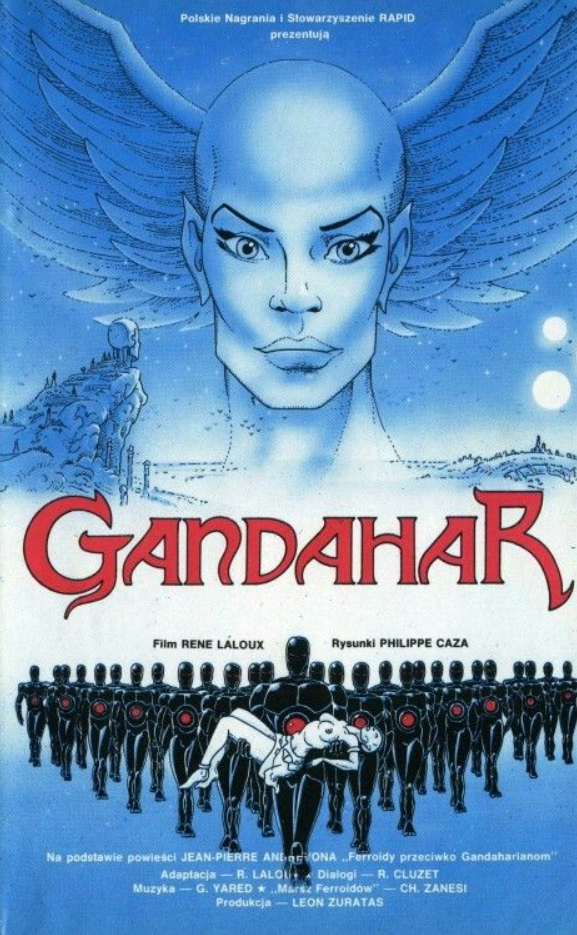
Coming to us from the same director as 1973’s Fantastic Planet, this film trades in that film’s stop-motion cutout animation for a more traditional 2D style. Make no mistake, though; this sci-fi adventure is every bit as weird as its more popular predecessor.
Life seems peaceful and idyllic on the planet of Gandahar, where its inhabitants live in harmony with nature and each other. But then everything changes when a robotic army of metal men attacks, firing laser beams that turn their victims into stone. Determined to get to the bottom of this, Queen Ambisextra (Anny Duperey/Glenn Close) and her Council of Women send her son, Sylvain (Pierre-Marie Escourrou/John Shea), to investigate. In his search for answers, Sylvain gains allies in the form of the Deformed (a tribe of humans warped into hideous forms by genetic experiments gone awry) and a beautiful young Gandaharian woman named Arielle (Catherine Chevallier/Jennifer Grey), whom he saves from the robots’ prison. He soon learns that the robot army was created by the ultimate failure of Gandaharian science: the giant brain Metamorphis (Georges Wilson/Christopher Plummer). But to destroy this evil, Sylvain must learn the meaning behind this Deformed prophecy: “In a thousand years, Gandahar was destroyed, and all its people massacred. A thousand years ago, Gandahar will be saved, and what can’t be avoided will be.”
As with any Laloux film, the animation is the real star of the show, presenting the environment of Gandahar with just as much stunning beauty as Ygam in Fantastic Planet. The creature designs (courtesy of noted comics artist Philippe “Caza” Cazaumayou) are a bit more naturalistic than the ones from Ygam, but are still no less weird and fantastical, from the leech-like creatures unleashed on the robots during the Gandaharians’ last stand to the flying creature Sylvain uses as his mount when he first sets off. The designs of the Deformed are also very creative, with the animators going all out to show the various ways that a human body can be twisted into a hideous parody of itself.
Of course, your enjoyment of Gandahar may be somewhat tempered by the fact that Laloux turned to a North Korean studio for the animation, and by the fact that the English dub was directed by none other than Harvey Weinstein (may his career rest in piss). Despite his involvement, though, I’d argue the English dub turned out rather well, thanks to the legendary Isaac Asimov being placed in charge of translating the script and the surprising amount of big names he booked for the roles. Aside from the ones mentioned above (Glenn Close, Jennifer Grey, Christopher Plummer, etc.), we also have David Johanson, Terrence Mann, and even Penn and Teller, the former voicing the Defomed’s chief.
The story is a little messy and might be hard to follow, given how much of it involves time-travel shenanigans. At its core, though, the story is a clear allegory about the dangers of fascism (unsurprisingly, Laloux grew up as a teenager in Nazi-occupied France), with the leader of the metal men even giving a speech at one point decrying the concept of individuality as a decadent luxury they have no use for, and that they must punish the Gandaharians for their indulgence in. The Deformed, in this light, could simultaneously be considered stand-ins for both indigenous cultures and disabled people, two groups that have historically suffered the worst from fascistic and colonialist projects. Their heroism and nobility in stopping Metamorphis’s evil plan could also serve as a moral that people should be judged by their individual actions rather than their appearance or the sins of their ancestors.
Like all of Rene Laloux’s films, Gandahar’s arthouse sensibilities mean it is firmly lodged in “cult classic” status. Still, for those interested in the weird side of sci-fi (and those who don’t mind Laloux’s proclivity for alien societies with no taboos against partial nudity), this is one you don’t want to miss, especially if you’re familiar with Fantastic Planet and want to know if the director has made anything else.
#582: Cats Don’t Dance
Animation style: Traditional 2D
Release date: March 26, 1997
Distributor: Warner Bros.
Production companies: Turner Feature Animation, David Kirschner Productions
Director: Mark Dindal
Writers: Rick Schneider, Robert Lence, Mark Dindal, Kelvin Yasuda, Brian McEntee, David Womersley (story); Bobs Gannaway, Cliff Ruby, Elana Lesser, Theresa Pettengill (screenplay)
Producers: David Kirschner, Paul Gertz
Music: Steve Goldstein (score); Randy Newman (songs)
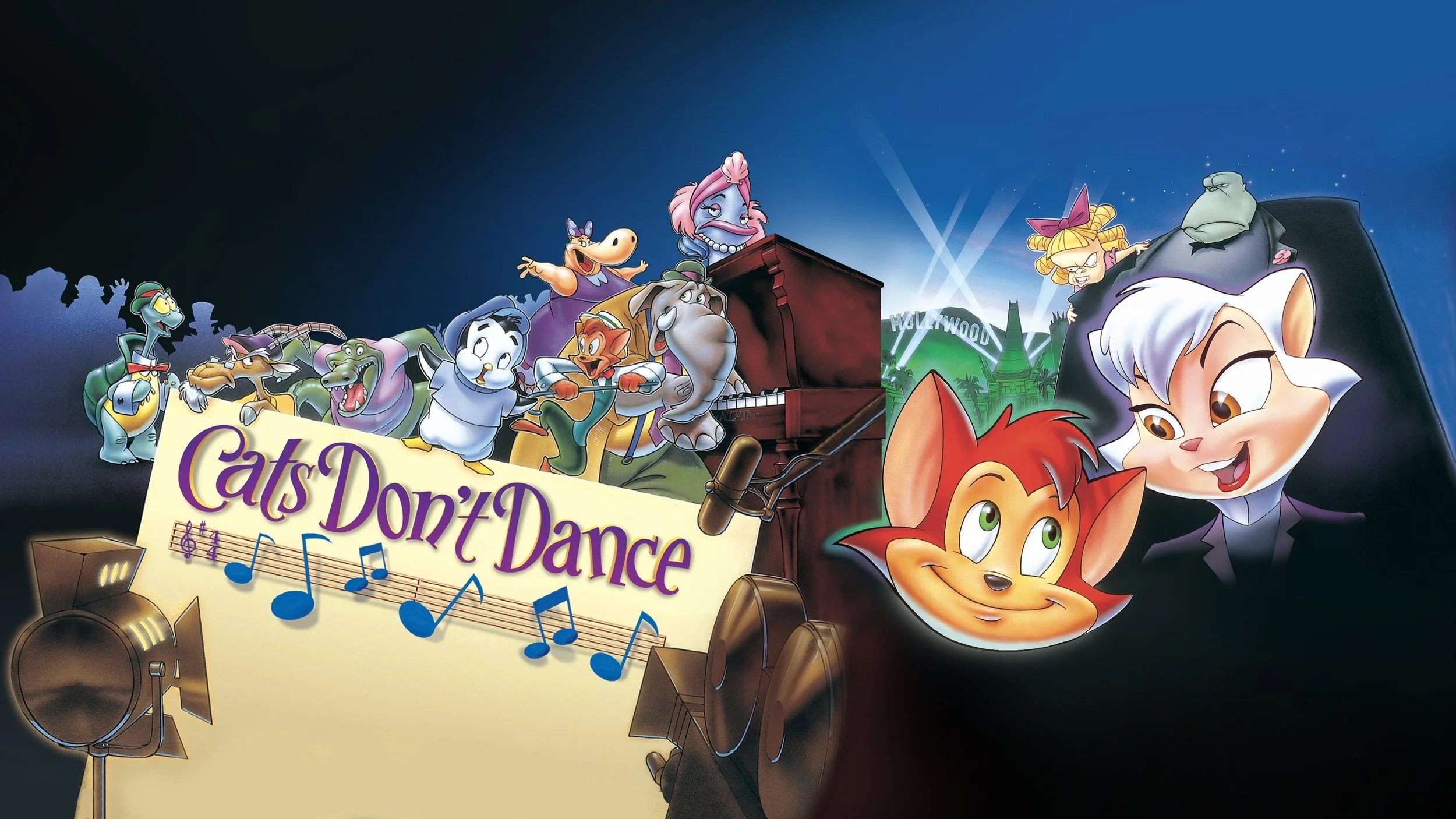
This late 90s cult classic (which started as a Roger Rabbit-type story starring Michael Jackson and choreographed by Gene Kelly before the former apparently lost interest) follows an orange cat named Danny (Scott Bakula) who travels from his hometown of Kokomo, Indiana, to Hollywood in 1939 with dreams of becoming a movie star. He is disappointed to discover that animals are not allowed to star in major motion pictures and becomes determined to change that. But to accomplish this goal, he’ll have to help his new friends overcome their cynicism (especially Sawyer (Jasmine Guy (speaking)/Natalie Cole (singing), a Turkish Angora secretary who gave up on singing due to Hollywood’s prejudice), as well as face off with Darla Dimple (Ashley Peldon/Lindsay Ridgeway), a popular child star who acts sickeningly sweet and innocent in public but is actually a vicious, spoiled brat who is probably the biggest animal hater in Hollywood. And she’s determined to deny the animals their spotlight at all costs.
I should warn you that if you’re hoping for a story with complex characters and deep themes, you may want to look elsewhere. Most of the characters aren’t fleshed out beyond their basic archetypes: Tillie (Kathy Najimy) as the energetic optimist, Cranston (Hal Holbrook) as the cranky old man, T.W. (Don Knotts) as the superstitious worrywart, Frances (Betty Lou Gerson) as the aging washed-up starlet, Pudge (Matthew Herried) as the cheerful tagalong kid, etc. Even Danny and Sawyer aren’t that deep; Sawyer’s arc is a bog-standard “defrosting ice queen” narrative, and Danny doesn’t really end the film any different than how he started, despite several setbacks.
This isn’t helped by the fact that the racism allegory isn’t really explored with any depth or nuance. We do see the effects that human prejudice has on the animals (especially with studio mascot Woolie (John Rhys-Davies), whose acting roles never extend beyond doing the sound effects for the Mammoth Studios logo, despite being a classically trained pianist), but then the racism problem is seemingly solved by the animals’ big climactic performance. Considering that Hollywood is still struggling with systemic racism even today, that ending feels a little overly optimistic and naive.
Despite those problems, this film is still essential viewing for its animation and music. The animation is lively, colorful, and energetic, especially during the music numbers. “Animal Jam” has the nice touch of the animals starting drab and desaturated, then brightening up as Danny gets them to join the dance. Both parts of “Big and Loud” show the two sides of Darla Dimple: first, the opulent public persona she presents to Danny; then, the vindictive, dark side hiding beneath the surface as she imagines herself as a godlike being raining torment on Danny and Sawyer. Finally, “Nothing’s Gonna Stop Us Now” delivers one of the most epic climaxes in any animated musical, helped by Darla’s attempts to sabotage it, which only make it even more epic.
Really, it’s almost Darla Dimple alone who makes this film worth watching. As a sociopathic child actor, she’s probably the most unique villain to come out of a Renaissance-era animated film. This is helped by Ashley Peldon’s intense performance, as she puts her all into making Darla as psychotic and deranged as possible, as well as Lindsey Ridgeway’s incredible singing on “Big and Loud” (she holds the final note for seventeen seconds!). Her gargantuan valet, Max (Mark Dindal impersonating Erich von Stroheim), is also a very enjoyable villain, who looks and acts more like Frankenstein’s monster than a butler and is highly entertaining with his booming voice and superhuman abilities.
Overall, what Cats Don’t Dance lacks in its writing and characters, it more than makes up for in its music and animation. The main characters are somewhat simplistic but still likable, and the villains are among the best in any 90s film. It’s probably no wonder it’s become a cult classic with qualities like that.
#606: Blue Submarine No. 6

Animation style: 2D/CG hybrid
Release date: October 25, 1998-March 25, 2000
Distributor: Discotek Media
Production company: Gonzo
Director: Mahiro Maeda
Writer: Hiroshi Yamaguchi (loosely based on the manga by Satoru Ozawa)
Producers: Kiyoshi Sugiyama, Shinji Nakajima, Tsunetoshi Koike, Yutaka Yano, Takao Nagayama
Music: The Thrill
This late-90s OVA secures its place in the history of animation as one of the earliest anime series to use extensive computer animation. While the results certainly look dated by today’s standards, the unique Waterworld/Island of Dr. Moreau/Hunt for Red October-style story that accompanies it is far too interesting to ignore.
It takes place in a post-apocalyptic version of Earth in which the mad scientist Jung Zorndyke (Takeshi Wakamatsu/Michael S. Way) caused a massive flood that drowned billions of people and left the rest at the mercy of his army of half-human, half-animal hybrids. The survivors are now racing to stop him before he finishes the job by using geothermal energy to induce a geomagnetic reversal, and their best hope is a submarine fleet led by the titular #6. To aid in these efforts, a young officer named Mayumi Kino (Yukana Nogami/Pamela Weidner-Houle) is sent to recruit a jaded former ace pilot, Tetsu Hayami (Hodzumi Gouda/Michael Granberry), who reluctantly joins despite his cynicism about the conflict. Many on both the human and hybrid sides are prepared to use nuclear weapons to ensure their victory. Still, Hayumi becomes convinced that there is a way for humans and hybrids to make peace, especially after he befriends a hybrid named Mutio (Miki Nagasawa/Juliet Cesario) after saving her life.
It’s really the animation that makes this OVA worth watching, not only for its early computer animation but also for being the first anime series to use digital ink and paint for its 2D scenes, presumably to help the 2D and CG elements blend more seamlessly. Yes, the CG is definitely crude by today’s standards. Still, it’s hard to imagine the series working as well without it, especially with the well-shot battle sequences between the enemy submarines and the whale-like Musica. The designs of the hybrids are also very creative, from the hotheaded sharklike admiral of the hybrid navy, Verg (Shoutarou Morikubo/Scott Simpson), to the catlike mermaid species that Mutio and her sisters belong to.
The story, on the other hand, feels rather undercooked, though not necessarily because it’s badly told but because of how short the anime is. With only four episodes (and only one longer than 28 minutes), we have about two hours and fifteen minutes to tell a story that probably needed at least ten episodes. We don’t get much time to get to know the characters with the breakneck pace (we don’t even learn why Zorndyke wants to wipe out humanity or how he caused the apocalyptic flood in the first place). Probably the only character that feels like they get proper development is Mutio, and even she seems to be forgotten about as the final showdown with Zorndyke draws ever closer, and her possible romantic subplot with Hayami goes unresolved.
Even with those writing flaws, I still think Blue Submarine No. 6 is well worth watching as a major milestone in the development of Japanese animation. The animation is well-done despite how much the CGI has aged, the character and mechanical designs are excellent, and the jazz/funk soundtrack works surprisingly well (even if it’s probably copying Cowboy Bebop’s homework a little bit). CG has been utilized with a little more finesse by several anime since then, but we should at least tip our hats to the first anime to make it such a big part of its art style.
#755: 5 Centimeters Per Second
Animation style: Traditional 2D
Release date: March 3, 2007
Distributors: Madman Entertainment, Anime Limited, GKIDS
Production company: CoMix Wave Inc.
Director/writer: Makoto Shinkai
Music: Tenmon
Makoto Shinkai’s least fantastical work may also be his most emotionally devastating, mostly because of its all-too-familiar central theme: the relationships we form and the way reality often conspires to slowly tear them apart.
Shinkai illustrates this through three chapters spanning a little over an hour. Chapter 1, “Cherry Blossoms,” introduces us to elementary schooler Takaki Tono (Kenji Mizuhashi/Johnny Young Bosch), who befriends Akari Shinohara (Yoshimi Kondo/Erica Weinstein) over their mutual interests, and follows the two over the course of the early 90s as their relationship develops, then is cut off when Takaki’s family moves from Tokyo to Kagoshima Prefecture, but not before he embarks on an arduous train journey to say goodbye to her. Chapter 2, “Cosmonaut,” shows Takaki attending high school on the island of Tanegashima, in the shadow of the Japanese space program, where he forms a new relationship with Kanae Sumida (Satomi Hanemura/Kira Buckland), who loves him but is unable to express it, as she can tell Takaki is searching for something she can never provide. In the final chapter, “5 Centimeters Per Second,” we follow Takaki and Akari, now grown up and back in Tokyo, where the former is in a depressive funk and still not over losing Akari, while Akari is engaged to another man. One day, they both find themselves back on a road they remember from their youth, where they promised to return to watch the cherry blossoms fall five centimeters per second again one day. But will they manage to reconnect, or will fate have one last trick up its sleeve to separate them once and for all?
I should warn you that this film does such a great job of setting up these relationships that you might get angry at the end when the characters don’t find a way to make it work. This may be especially true for anyone who’s seen literally any other Shinkai film, where everything almost always works out for the protagonists. However, keep in mind that most of those other films have fantasy or science fiction elements, which means they’re already bending the rules of reality. 5 Centimeters Per Second could thus be considered Shinkai’s reminder to his viewers that real life doesn’t always have that kind of fairy-tale ending. More often than not, the opposite is true. Perhaps Theron Martin at Anime News Network puts it best:
Whereas Voices [of a Distant Star] was about trying to maintain a connection and [The] Place Promised [In Our Early Days] was about reestablishing one, Five Centimeters is ultimately about moving on from past connections instead of just living in the past, about finding a way to become happy in the present rather than just pining for what has been lost over time. In that sense Five Centimeters is Shinkai's most mature and complicated work yet.
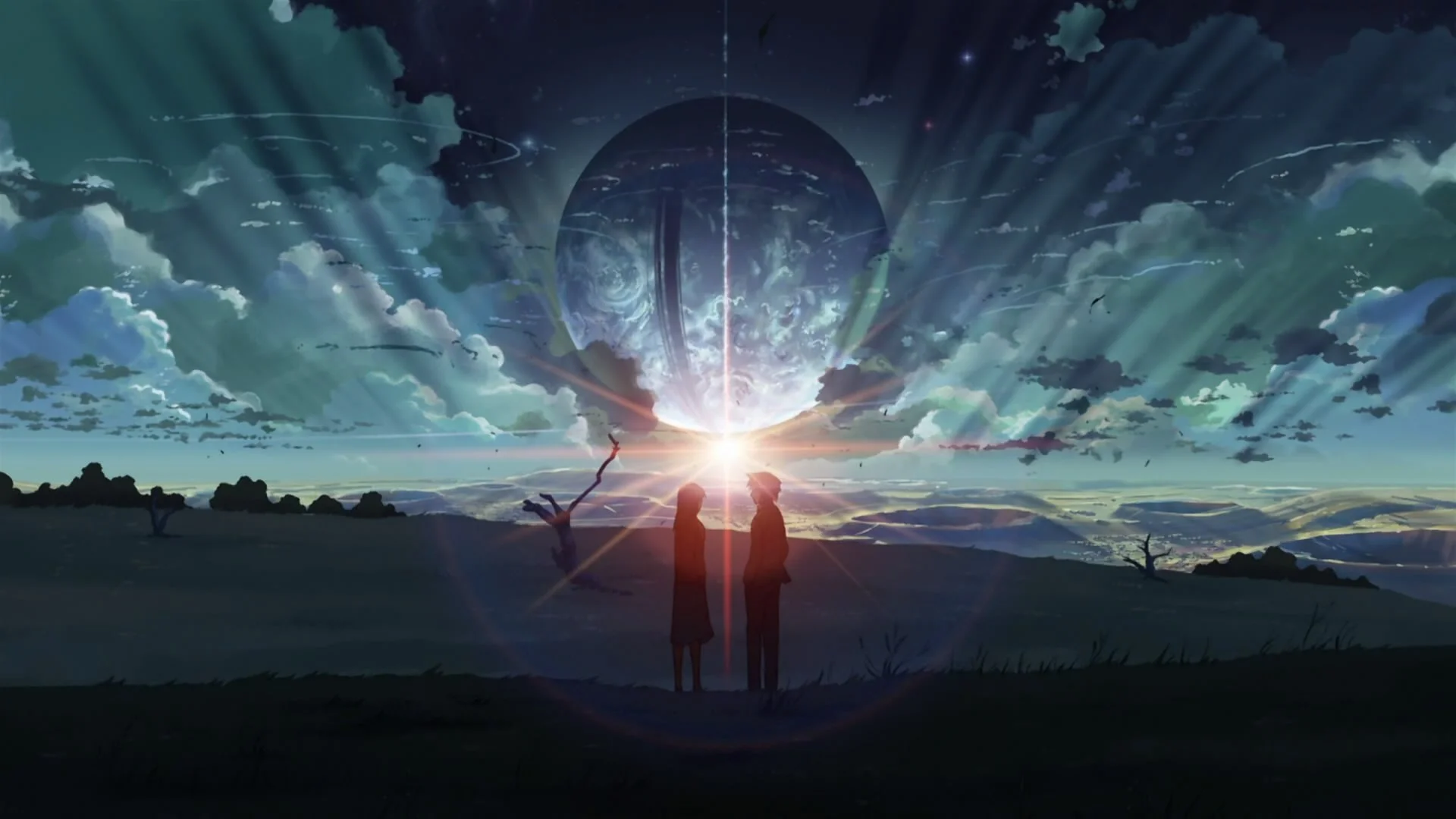
Probably the only disappointing part of 5 Centimeters is its character animation, which is much rougher than in his later works like Weathering With You or Suzume. Even so, this is still Makoto Shinkai we’re talking about, so it’s still well above average. He manages to get around these shortcomings by focusing more on the environment surrounding the characters, such as the immaculate winter landscapes surrounding Takaki during his fateful final train trip to Tochigi, the cherry tree that bookends the film, and the symbolic alien sky that keeps showing up in Takaki’s dreams (pictured above). The music, consisting mostly of slow and contemplative piano pieces, is also excellent, as is the use of the popular Japanese song “One More Time, One More Chance,” which plays over the montage in chapter 3.
Maybe you’ll be less forgiving of the lack of resolution in the ending than I am. However, I think you still owe it to yourself to view this modern anime masterpiece, especially if you were introduced to Makoto Shinkai through his later works and want to see where he got his start.
#815: Despicable Me
Animation style: 3D CG
Release date: June 9, 2010
Distributor: Universal Pictures
Production company: Illumination Entertainment
Directors: Chris Renaud, Pierre Coffin
Writers: Sergio Pablos (story); Cinco Paul, Ken Daurio (screenplay)
Producers: Chris Meledandri, Janet Healy, John Cohen
Music: Pharrell Williams (songs); Heitor Pereira (score)
Is it weird to include an Illumination feature in the same list that includes Gandahar and Maquia? Yeah, probably, but this is still an important film in the history of American animation, even if the reasons for that aren’t entirely positive.
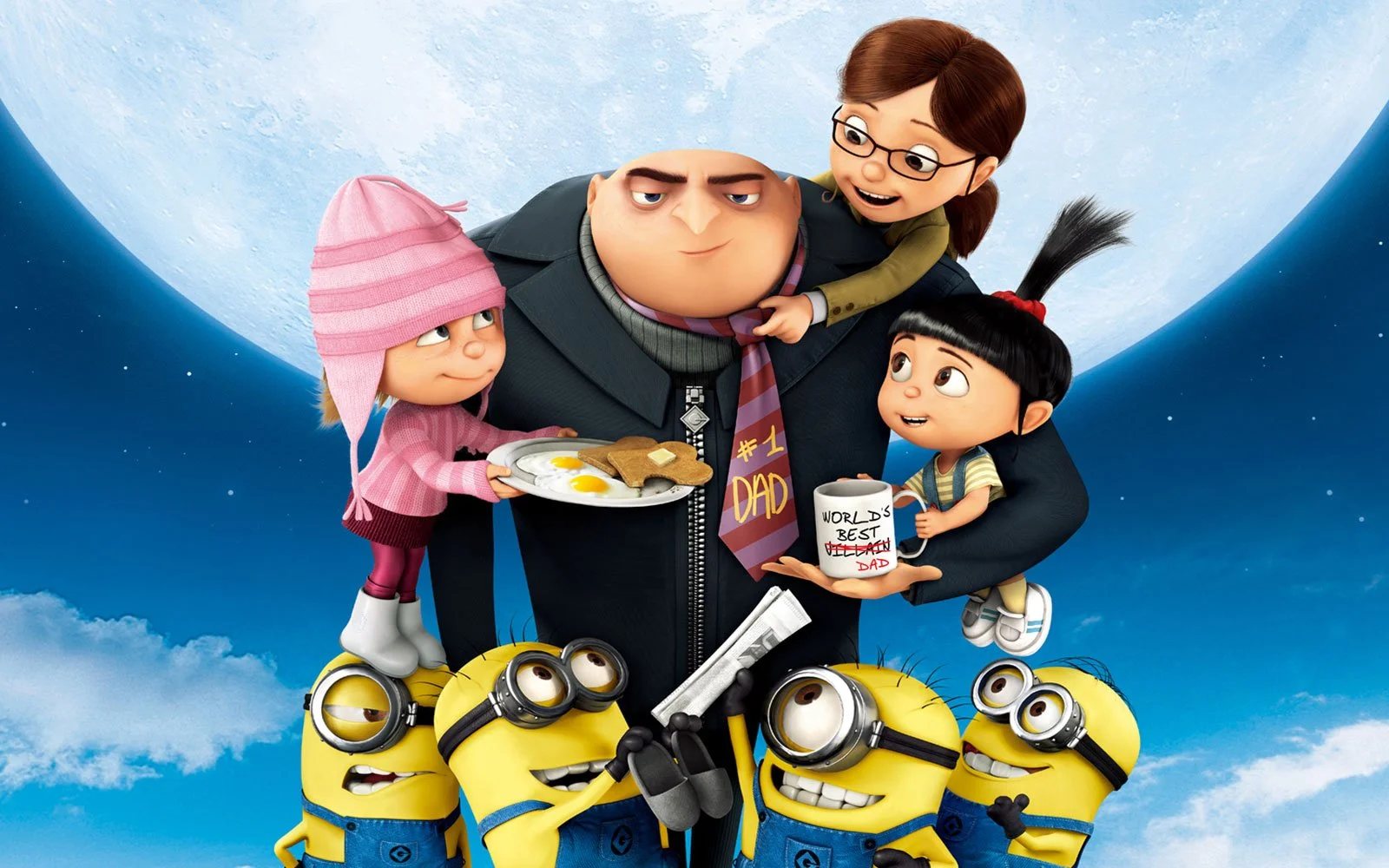
The story revolves around an aging supervillain named Felonious Gru (Steve Carell), who is struggling to keep up with the many younger supervillains popping up everywhere. He becomes especially jealous when one up-and-comer named Vector (Jason Segel) pulls off the “crime of the century” by stealing the Great Pyramid of Giza, and decides that the only way to top that is to steal the Moon. He steals a shrink ray from a research base in Southeast Asia, only to have Vector come along shortly afterward and steal the shrink ray from him in turn. After several failed attempts to infiltrate Vector’s lair, he notices three orphan girls: the mature and serious Margo (Miranda Cosgrove), the sarcastic tomboy middle child Edith (Dana Gaier), and the oddball toddler Agnes (Elsie Fisher), whom Vector purchases cookies from. Sensing an opportunity, Gru decides to adopt the girls to use them in his nefarious lunar heist. But Gru soon finds himself growing more and more attached to the girls, and may soon need to choose between becoming the world’s greatest supervillain and the world’s greatest dad.
Illumination has since gained a reputation for being artistically unambitious and for focusing too much on the lowest common denominator, and not without good reason. CEO Chris Meledandri has even admitted that he intentionally tries to keep the cost of the studio’s movies as low as possible to increase the chances of box office success, and making his movies as kid-friendly as possible probably doesn’t hurt. The Minions are probably the clearest illustration of this vacuity, with Illumination adopting them as the studio mascots and marketing them so aggressively that many people (myself included) have grown beyond sick of seeing them everywhere.
Despite this, Despicable Me still ranks as one of their few genuinely good films because it has something most other Illumination films lack: emotional depth. For all the silliness that surrounds it, Gru’s arc is treated with the utmost seriousness, as it quickly becomes clear that he’s grown genuinely fond of the girls and that they’re helping fill the hole left by the way his uncaring mother, Marlena (Julie Andrews), raised him. It’s genuinely sweet watching Gru go from a neglectful curmudgeon when the girls first arrive to a devoted and loving father.
It helps that a lot of the comedy is genuinely funny and isn’t afraid to go to surprisingly dark places at times. I definitely wasn’t expecting the fakeout with Edith and the iron maiden, or the fact that the Bank of Evil Gru tries to get funds from for the lunar heist was “formerly Lehman Brothers.” The Looney Tunes-style hijinks that Gru and Vector get up to led many critics to dub the film “Wiley E. Coyote vs. Wiley E. Coyote.” Even Gru’s elderly assistant manages to get some laughs, despite being voiced by Russell Brand (may his career rest in piss), thanks to the numerous misunderstandings when it comes to making gadgets in Gru’s lab (like making boogie robots instead of cookie robots and a fart gun instead of a dart gun).
Even if it’s clear by now that Illumination may have taken the wrong lessons from its success, Despicable Me is still a charming and funny film for the whole family, with memorable characters, a well-crafted story, and great animation for a lower-budgeted work. Even if you’re sick of seeing the Minions everywhere, I’d say it’s worth it to give their debut feature a shot.
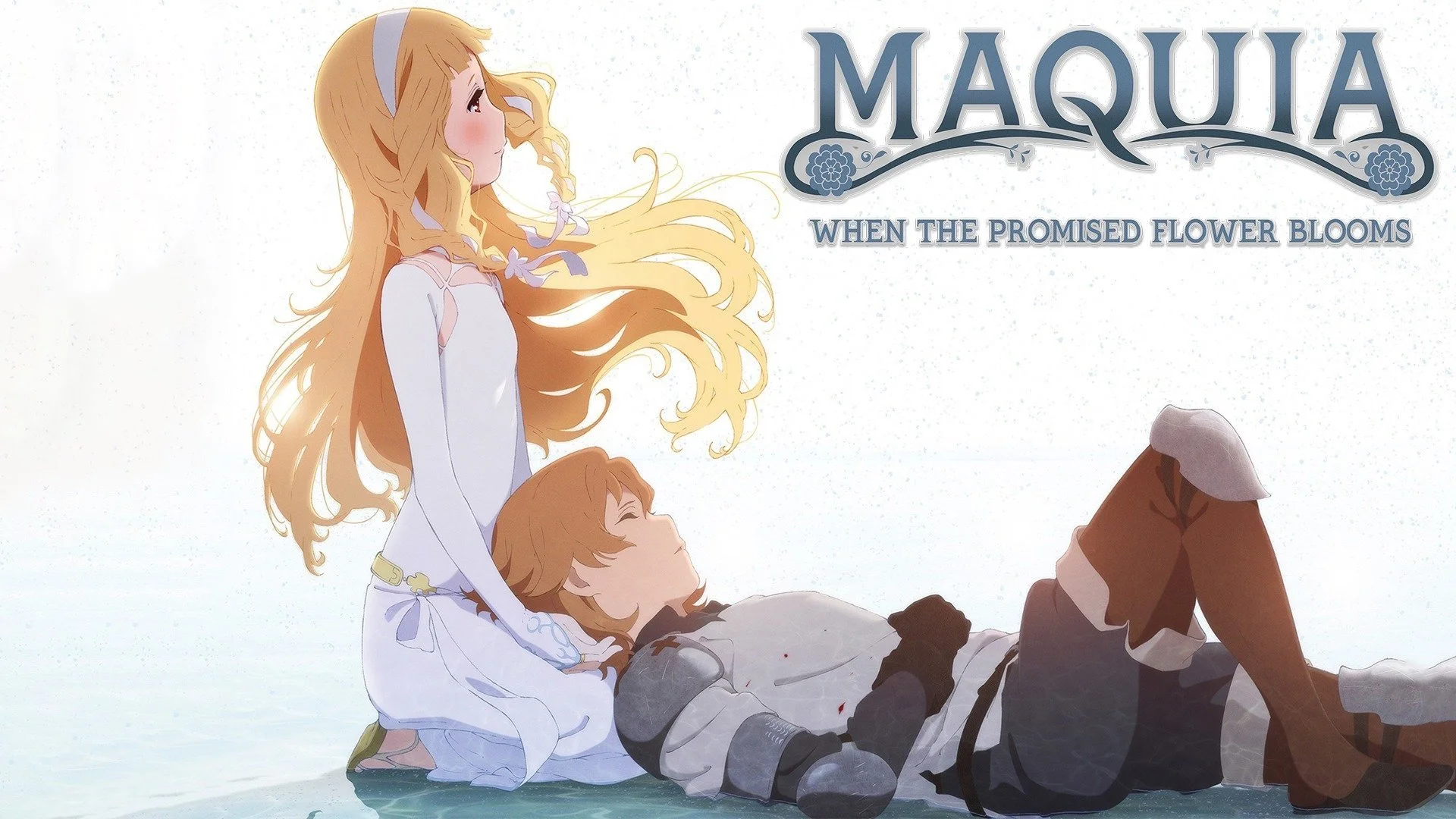
#932: Maquia: When the Promised Flower Blooms
Animation style: Traditional 2D
Release date: February 24, 2018
Distributor: Showgate
Production company: P.A. Works
Director/writer: Mari Okada
Producers: Naoko Endo, Tomomi Kyotani, Nobuhiro Takenaka, Nobuhiro Kikuchi
Music: Kenji Kawai
I’m not gonna lie to you, guys: this is the first movie I’ve watched in a long time that’s actually made me cry. When you learn how this modern-day fantasy classic uses its elflike protagonists, you’ll understand why.
Life for the humanoid Iorph race seems rather idyllic at first, as they spend their days weaving their Hibiol cloth, which serves as a record of the passage of time. Unfortunately, the quality that separates them from humans-their unnaturally long lifespan-attracts the attention of the kingdom of Mezarte, who swoop in on their dragonlike Renato mounts, ransack their village, kill most of the Iorph, and kidnap the rest. The sole escapee, Maquia (Manaka Iwami/Xanthe Huynh), almost throws herself off a cliff in her grief, but then hears a baby crying in the distance. She adopts the baby, whom she names Ariel (Miyu Irino/Eddy Lee), and raises him as her own. But their relationship becomes strained as Ariel grows older, not only because of the ongoing political oppression of the Iorph by Mezarte but also because Maquia still resembles a fifteen-year-old girl whilst Ariel ages like a normal human…
This film sets itself apart from many of its Tolkien-esque peers with its ruminations on motherhood, the inexorable passage of time, and what it inevitably takes from us. Such themes are especially poignant when examined through the lens of Maquia and Ariel’s relationship, with the latter growing increasingly resentful of his adoptive mother as he ages and she doesn’t, and being forced to call her his sister instead. Needless to say, Iorph elder Racine’s (Miyuki Sawashiro/Lipica Shah) warning to a wanderlust-stricken Maquia that “If you fall in love [with someone from the outside], you will become truly alone” ends up hanging over her hard like a funeral shroud as the years go by.
The film also deals with themes of racism and colonialism in the way Mezarte treats the Iorph, with Leilia (Ai Kayano/Cherami Leigh) and Krim (Yuki Kaji/Kevin T. Collins) as the saddest expression of these themes. Leilia is imprisoned in the king’s castle and unwillingly used as a brood mare in the hopes that her human captors can breed the Iorph’s longevity into their bloodline, while Krim sacrifices more and more of his humanity in his increasingly fanatical efforts to rescue Leilia and destroy Mezarte.
While the film itself is more grounded and less epic than other fantasy films, the animation certainly treats it with the grandiosity and beauty that any film featuring dragons and castles deserves (which is all the more impressive considering that this is P.A. Works’ first feature film). It’s aided by a beautiful soundtrack and voice acting to lend this tale of love and loss all of the heartbreaking pathos it requires.
Aside from some hiccups in the story (like the buildup to the climactic battle between Mezarte and its rival kingdoms not being quite as developed as I’d like), Maquia: When the Promised Flower Blooms is such an effectively emotional rollercoaster that it’s kind of hard to care. No less a figure than Makoto Shinkai opined on Twitter that “When someone delivers this level of quality in their directorial debut, it sparks both jealousy and a sense of urgency in me.” If that’s not high praise, I don’t know what is.
Well, there goes another one!
I think this entry is notable in that I didn’t feel the need to say “This might not be for everyone” as much as in the previous entries. I feel like a lot of the shows and movies I described here have much wider appeal than others I’ve discussed on “1001 Animations.” Of course, that’s probably not universally true: Gandahar is definitely a very “arthouse” kind of film, and there’s enough casual nudity among the hybrids in Blue Submarine No. 6 that it might turn some people off. Still, if you’re as much of an animation fanatic as I am, it’s probably worth it to see any one of these at least once.
I’m not going to go into detail about the near future of this blog right now, since I have enough projects in the works (as well as real-life stuff going on behind the scenes) that I think I may need to make a dedicated update post to talk about it all, so expect that sometime later this week. I know enough to tell you that the next real article will be the one about lesser-known animations from 2022 that I don’t think got the attention they deserved, and that the long-awaited conclusion to my Jurassic Park retrospective may finally be coming this June!
We’ll see how that shakes out in the coming weeks. Until then, stay whacky, fellow animanaics!